How to Optimize for AI Search
The surprising part about AI search is that your SEO playbook probably isn't dead. It's just incomplete. Google's own guidance says traditional SEO fundamentals still drive visibility, while structured data like Merchant Center feeds and on-page schema help products and services appear in AI responses and other Search results. The same guidance also warns against chasing unnecessary tactics like llms.txt for Google Search, which is a strong signal that AI visibility starts with crawlable pages, clear structure, and machine-readable data, not gimmicks or “AI hacks” (Google's AI optimization guide).
For DTC brands, that changes the target. You're no longer optimizing only to rank a category page. You're optimizing so an AI shopping assistant can confidently recommend a specific SKU, explain your return policy, confirm shipping constraints, and trust that the price and availability it found are still current.
Table of Contents
- Why Your Google SEO Strategy Fails in AI Search
- Building Your Store's AI Knowledge Base
- Mastering Schema for Product Discovery
- How to Control and Direct AI Crawlers
- Measuring and Monitoring Your AI Visibility
- Frequently Asked Questions About AI Optimization
Why Your Google SEO Strategy Fails in AI Search
A page can rank well and still be useless to an AI assistant.
That's the mistake most merchants make. They assume ranking signals and AI recommendation signals are basically the same. They aren't. A search engine can send a user to your page because it seems relevant. An AI assistant has to extract the answer, compare it with alternatives, and decide whether your product data is trustworthy enough to repeat back to the shopper.
Google has been unusually clear on this point. It says AI search visibility depends on whether systems can reliably extract and trust page content, not just whether the page matches keywords. It also notes that AI answers favor modular, self-contained sections and concise, verifiable claims, which means merchants need to design product and policy pages as machine-readable answer blocks instead of treating them as pure copywriting exercises (Google's guidance on succeeding in AI search).
Ranking pages and answering questions are different jobs
Classic SEO is like handing a shopper a list of stores.
AI search is like sending a retail associate who has to come back with one recommendation and explain why.
That difference changes what matters on the page:
- Keywords matter less on their own because the system isn't only matching terms. It's interpreting attributes, policies, and product suitability.
- Page design matters differently because hidden details, vague bullets, and scattered policy text are hard to reuse in an answer.
- Trust signals need to be explicit because the model has to decide whether your claim is specific enough to cite.
A category page built to target “best running shoes for women” may still perform in Google. But if the page doesn't expose sizes, material, shipping limitations, return rules, and product distinctions in a clean structure, an AI shopping assistant may skip it.
Most stores don't have an authority problem first. They have a retrievability problem.
Old SEO habits can become liabilities
Long introductions, vague brand storytelling, collapsed FAQs, and product details buried in tabs all create friction for AI extraction.
That's why merchants who want to understand why Shopify catalogs stay invisible in AI search should stop asking only, “What keyword should this page rank for?” and start asking, “Can a machine extract the exact answer from this page without guessing?”
Use this quick filter on every commercial page:
| Page element | Good for classic SEO | Good for AI search |
|---|---|---|
| Keyword-rich intro copy | Sometimes | Only if it contains usable facts |
| Clear price and availability | Yes | Yes, critical |
| Shipping and returns on-page | Helpful | Critical |
| Structured product attributes | Helpful | Critical |
| Self-contained FAQ blocks | Helpful | High value |
If you're still treating AI search like a slightly smarter version of Google, you'll optimize the wrong things first.
Building Your Store's AI Knowledge Base
AI shopping assistants recommend products from stores that publish usable facts, not stores that force the model to piece answers together.
For DTC brands, that changes the job. The goal is no longer just ranking a page for a category term. The goal is making product, policy, and support information easy to retrieve at the exact moment an assistant decides what to recommend.
What belongs in the knowledge base
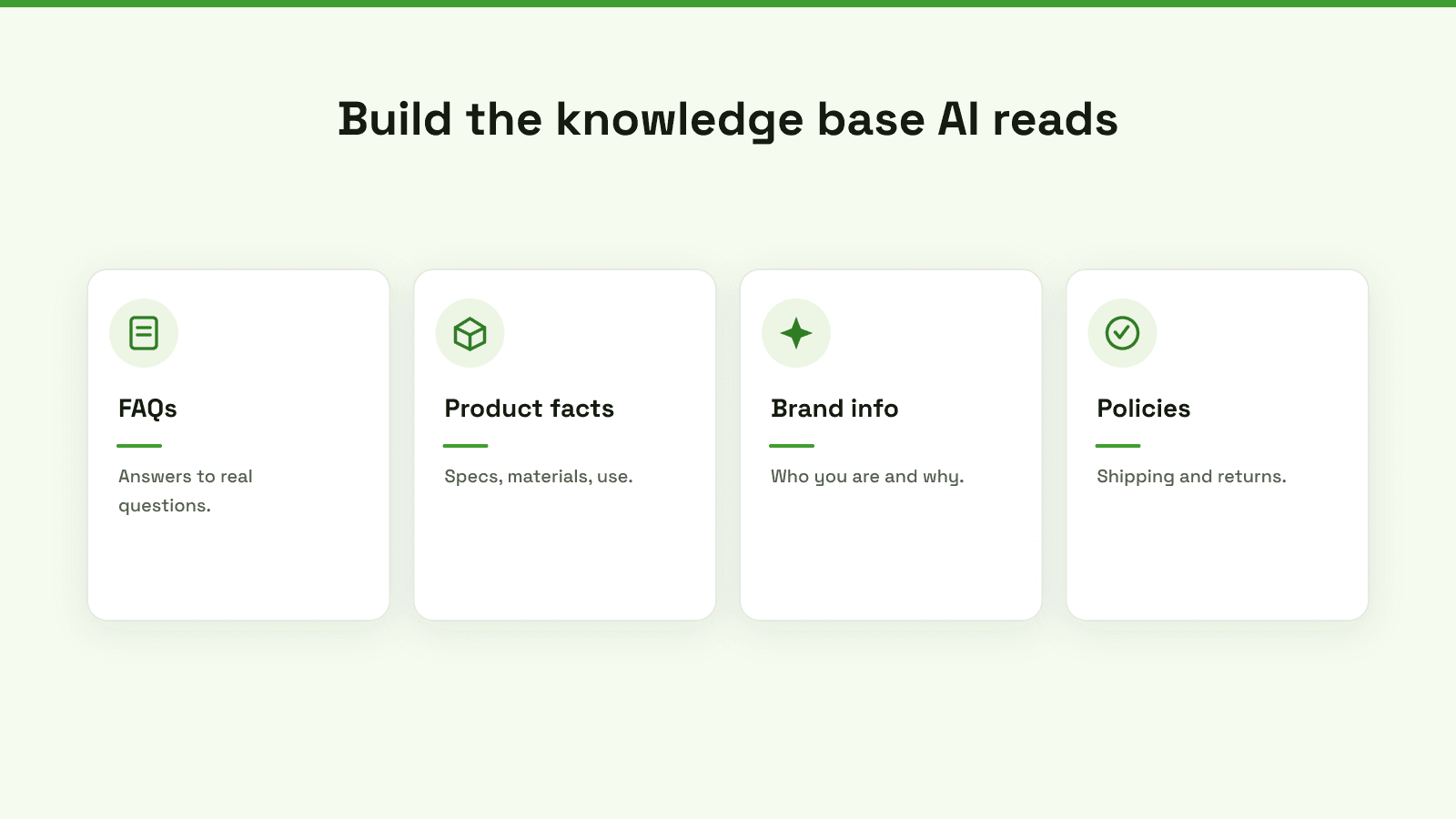
An AI knowledge base is the store layer that turns scattered facts into retrievable answers. On many ecommerce sites, those facts already exist. They are just split across PDPs, shipping pages, help center articles, return policies, collection copy, and app-generated content. That fragmentation hurts product recommendation visibility because assistants prefer sources with fewer gaps and fewer contradictions.
A useful store knowledge base usually includes:
- Product facts such as title, variants, materials, dimensions, compatibility, intended use, price, and stock status
- Commercial rules such as shipping regions, delivery timing, return windows, exclusions, warranty terms, and preorder conditions
- Brand context such as who the products are for, what problems they solve, and where they fit in the category
- Pre-purchase support answers that address repeated objections before checkout
- Decision-stage content such as comparisons, buying guides, and category explainers
AI shopping flows are product-led. If a shopper asks, “Which of these ships fastest?” or “Which option is better for sensitive skin?” the assistant needs exact store facts. Brand-level messaging helps. Product-level clarity gets cited.
Organize around buying jobs, not publishing habits
A lot of content calendars are built around campaigns, launches, and seasonal themes. AI systems reward content built around buying decisions.
For an apparel brand, that structure might include a category guide for waterproof outerwear, a comparison page for shell types, a fit and layering guide, a care page, and a pre-purchase FAQ focused on delivery and returns for that category.
For a supplement brand, the stronger cluster is usually different. Ingredient explanations, usage timing, product comparisons, sensitivities, and subscription terms answer more buying questions than lifestyle articles do.
Independent guidance from the Digital Marketing Institute on optimizing content for AI search recommends organizing content into pillar pages and supporting subpages, then adding schema so machines can interpret the content more reliably. It also highlights signals that increase citation likelihood, including original information, verifiable claims, visible expertise, and fresh update dates.
I would treat that as an operational filter, not a content theory exercise. If a topic helps a shopper choose, compare, qualify, or trust a product, it belongs in the knowledge base. If it only exists to fill a blog calendar, it usually does not.
Build a single source of truth for commercial facts
The practical problem is consistency.
Many stores say one thing on the PDP, another thing in the help center, and a third thing at checkout. That creates risk for shoppers and for AI systems. If shipping cutoff times, return windows, subscription terms, or bundle rules conflict across pages, assistants may avoid citing the store at all.
A workable approach is to define a source of truth for each fact type, then syndicate that information across the site. Product specs should come from the catalog. Shipping rules should come from one maintained policy source. Returns logic should not live in five slightly different FAQ answers.
For Shopify teams, Shoptank's guide to building an AI knowledge base for Shopify stores shows one way to structure product, pricing, and policy data so AI systems can consume it more reliably. The tool is less important than the operating principle. Stores need a connected fact layer, not isolated pages written by different teams at different times.
Operational rule: If a shopper could ask it before buying, your store should answer it clearly on-site, in a format that does not require the model to merge conflicting snippets.
Freshness affects whether your products stay recommendable
Freshness is not just a blog concern. In ecommerce, it affects whether a recommendation stays safe to make.
A store's knowledge base needs regular updates in four places:
- Policy content when shipping zones, return rules, or warranty terms change
- Catalog content when products are discontinued, renamed, or replaced
- Offer content when pricing, bundle logic, or availability changes
- Support content when common pre-purchase questions shift after merchandising or checkout updates
The trade-off is straightforward. Publishing more buying guidance creates more surfaces for AI discovery, but it also creates more pages that can drift out of date. Brands that win here usually reduce duplication, centralize facts, and update high-impact commercial pages before expanding into more top-of-funnel content.
A stale article can lose citations. A stale PDP can lose recommendations. For DTC brands, that is the bigger risk.
Mastering Schema for Product Discovery
AI shopping assistants do not recommend products because a PDP sounds persuasive. They recommend products when they can extract clear facts, trust those facts, and match them to the shopper's intent.
That makes schema a product discovery system, not a technical afterthought.
Why product pages fail extraction
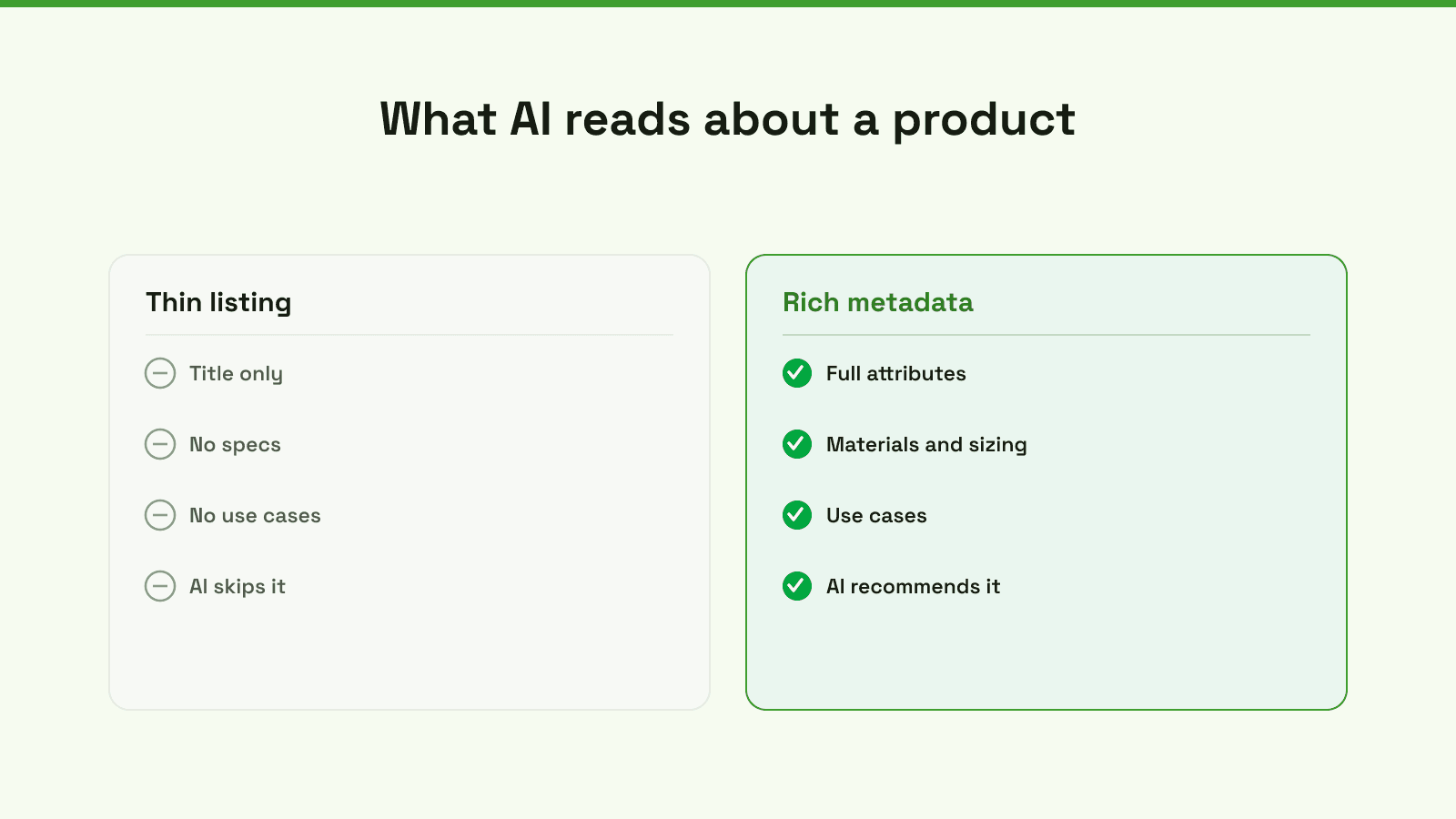
Many DTC product pages are built for visual merchandising first. Swatches, lifestyle imagery, collapsible tabs, sticky add-to-cart bars. Those elements can help conversion. They often leave machines guessing about the basics.
A page that says:
Lightweight everyday sneaker with premium comfort, sleek profile, and all-day versatility.
still leaves major gaps. A model may not know the material, intended activity, fit constraints, current price, shipping restrictions, or return terms unless those facts are exposed clearly in structured fields and visible copy.
That is the shift brands need to accept. AI optimization is not about getting your homepage mentioned. It is about making individual products easy to retrieve, compare, and recommend with confidence.
The schema stack that actually matters on PDPs
For most Shopify stores, the starting point is straightforward. Get the core commercial signals into markup that matches the page.
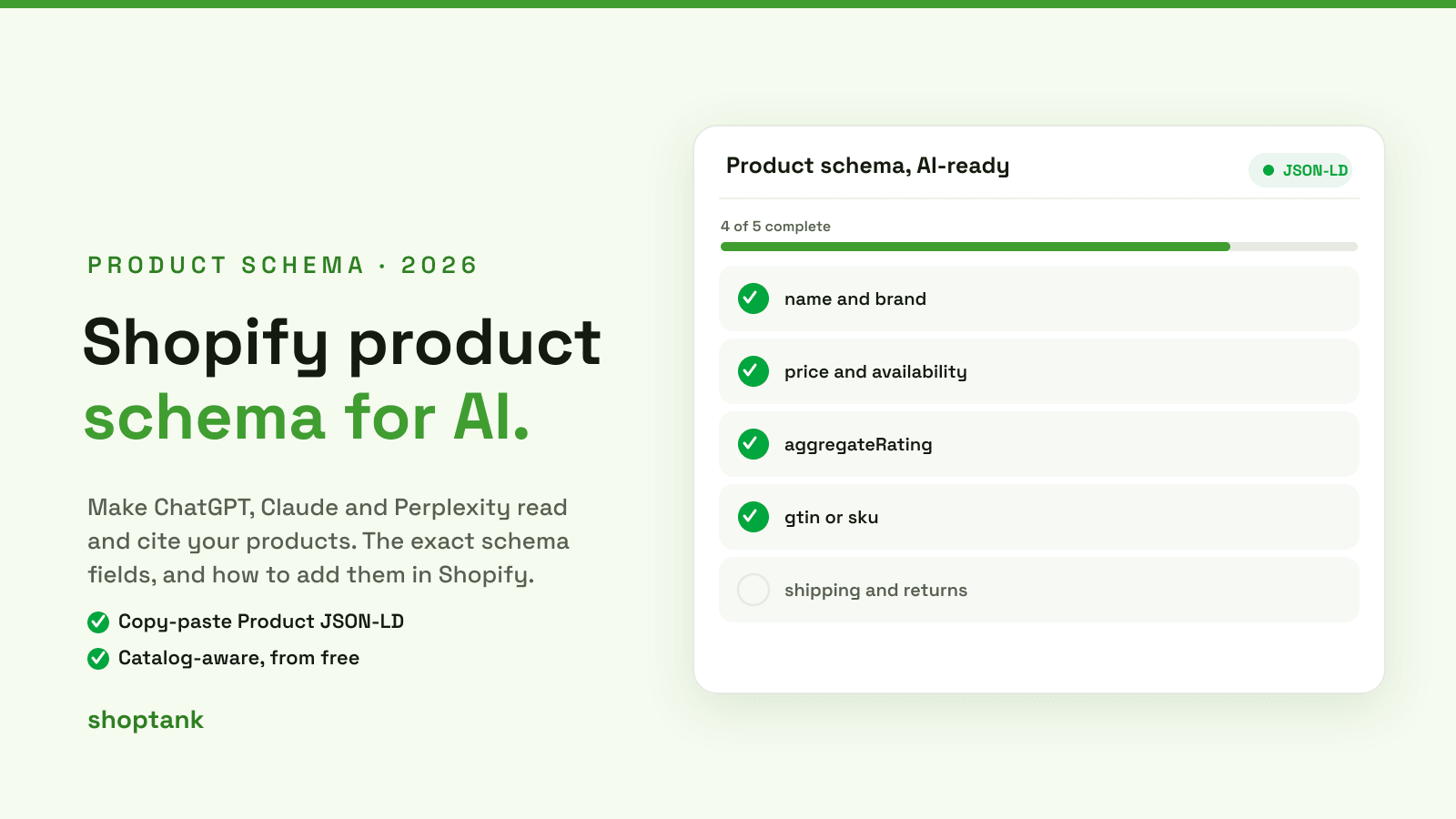
Productfor identity and attribute data such as name, brand, description, SKU, GTIN, color, size, and material where relevantOfferfor the buy-now state, including price, currency, availability, and canonical product URLOfferShippingDetailsfor shipping regions, rates, or thresholds when delivery conditions affect whether the product is a safe recommendation- FAQ-related markup where appropriate for high-friction buying questions like sizing, compatibility, returns, or care instructions
The trade-off is maintenance. More schema fields create better machine context, but they also create more ways for merchandising, feeds, apps, and theme content to fall out of sync. If the page says one thing and the markup says another, recommendation systems have a reason to distrust both.
Here is the review standard I use for commerce teams:
| Schema type | What it should clarify | Why AI cares |
|---|---|---|
Product | Name, description, brand, variant facts | Identifies the product correctly |
Offer | Price, currency, availability, URL | Confirms that the item can be purchased now |
OfferShippingDetails | Delivery regions or shipping conditions | Filters recommendations by fulfillment fit |
| FAQ-related markup where appropriate | Returns, sizing, compatibility | Helps answer pre-purchase objections |
What stronger product markup looks like
Below is a simplified pattern. It is not a substitute for development review, but it shows what machine-readable product detail looks like in practice.
{
  "@context": "https://schema.org",
  "@type": "Product",
  "name": "AeroFlex Runner",
  "brand": {
    "@type": "Brand",
    "name": "AeroFlex"
  },
  "description": "Breathable everyday running shoe with mesh upper and cushioned sole.",
  "offers": {
    "@type": "Offer",
    "priceCurrency": "USD",
    "price": "129.00",
    "availability": "https://schema.org/InStock",
    "url": "https://example.com/products/aeroflex-runner"
  }
}
That gives a shopping assistant usable facts. Adjective-heavy copy does not.
If shipping terms influence the purchase decision, expose them in markup too.
{
  "@context": "https://schema.org",
  "@type": "OfferShippingDetails",
  "shippingDestination": {
    "@type": "DefinedRegion",
    "addressCountry": "US"
  }
}
The exact implementation depends on your theme, apps, and fulfillment setup. The principle stays the same. If a machine cannot read the commercial state of the product cleanly, it is less likely to surface that product in a recommendation.
A practical QA test helps here. Open a PDP and ask whether an AI shopping assistant could answer these questions without checking another page:
- What exactly is the product?
- What does it cost right now?
- Is it in stock?
- Where can it ship?
- What happens if the customer needs to return it?
If any of those answers live only in tabs, pop-ups, footer policy pages, or third-party widgets, the PDP is still weak for AI discovery.
For merchants who want a more operational view, this breakdown of how a Shopify AI catalog works shows how structured catalog data shapes what AI systems can use.
A short walkthrough can help if you're briefing a developer or QA team:
Schema does not fix a weak product or unclear positioning. It does decide whether a strong product is legible enough to be recommended. For DTC brands chasing AI-driven revenue, that distinction matters.
How to Control and Direct AI Crawlers
The hard truth about llms.txt is that merchants talk about it far more than they understand it.
Some treat it like the master key to AI visibility. Others dismiss it entirely. Its actual scope is narrower. It can be useful as a signaling layer for some AI-facing workflows, but it is not a replacement for crawlable pages, strong structured data, or visible policy content. Google explicitly says not to rely on unnecessary tactics like llms.txt for Google Search in its AI optimization documentation, which is why merchants should keep it in perspective. It's optional and situational, not the foundation.
What control actually means
Start with the distinction that matters:
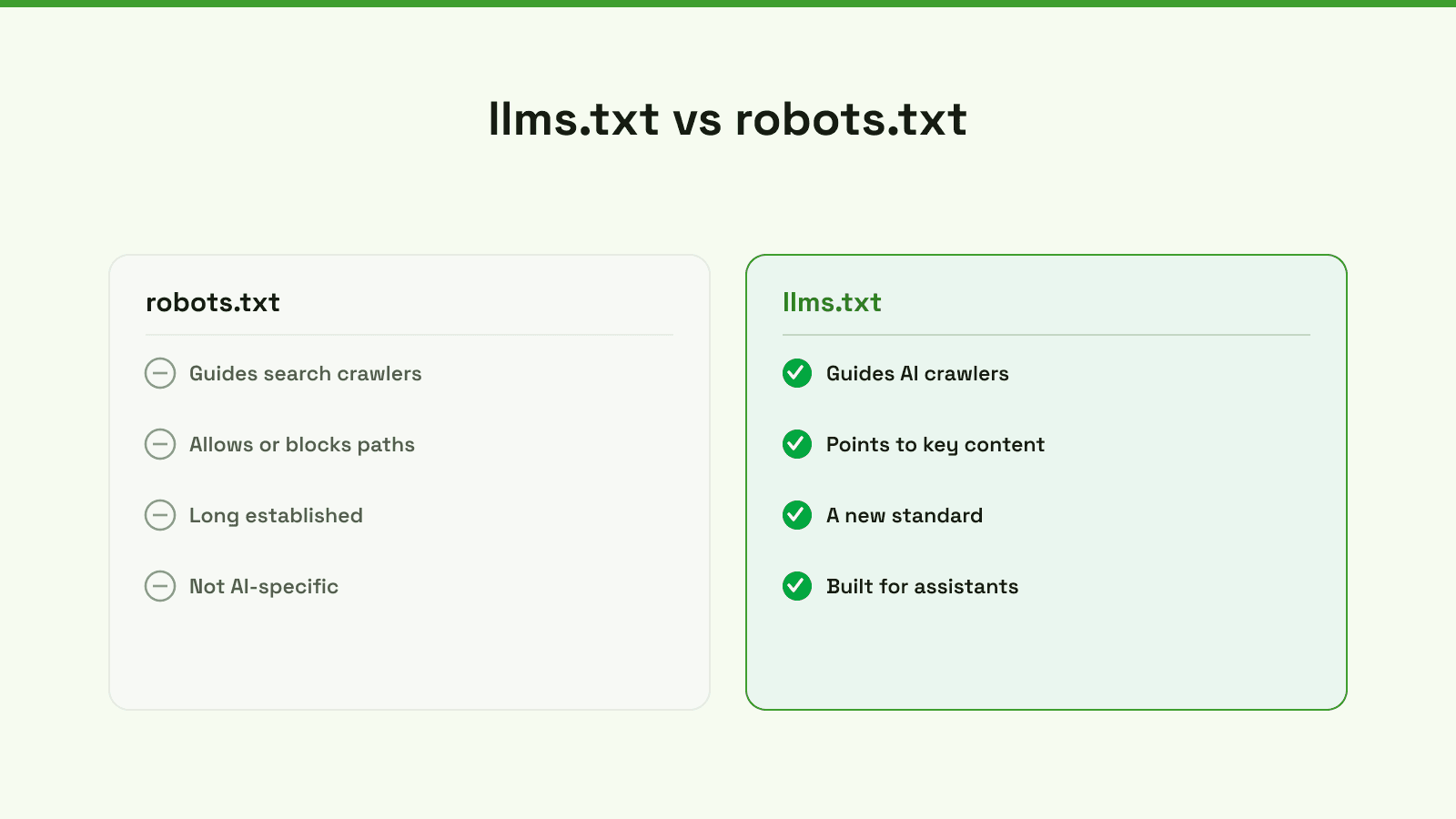
| File | Primary purpose | What merchants should expect |
|---|---|---|
robots.txt | Crawl guidance for traditional search bots | A long-established access control tool |
llms.txt | A voluntary instruction layer for AI-related use cases | Directional guidance, not guaranteed enforcement |
That distinction matters because many teams overestimate what a text file can do. It can express preference. It doesn't guarantee adoption across all AI systems.
A practical policy for crawler access
Use crawler control to support business goals, not because it sounds advanced.
For most stores, the sensible approach looks like this:
- Allow useful public catalog content because product pages, collection pages, and core policy pages are exactly what recommendation systems need
- Keep thin, duplicated, or private sections out of scope such as account pages, internal search results, or low-value utility URLs
- Align instructions with visible content because a crawler directive won't fix contradictions between your schema, your feed, and the page itself
A lightweight llms.txt style example might look like this in concept:
Allow access to product, collection, FAQ, shipping, and returns content. Avoid directing models toward duplicate review fragments, account areas, or obsolete landing pages.
That's strategy, not syntax theater.
The bigger risk is using crawler-control files as a distraction from page quality. If your shipping page is vague, your returns rules are inconsistent, or your PDPs don't expose structured attributes, no access file will solve the underlying problem.
The stores that gain ground in AI search usually make their best answers easier to retrieve. They don't spend months polishing optional control layers while core product data stays messy.
Use robots.txt for established crawl management. Treat llms.txt as an experimental communication layer where relevant to your workflow. Keep expectations realistic.
Measuring and Monitoring Your AI Visibility
Teams often measure AI search badly because they test for ego, not revenue.
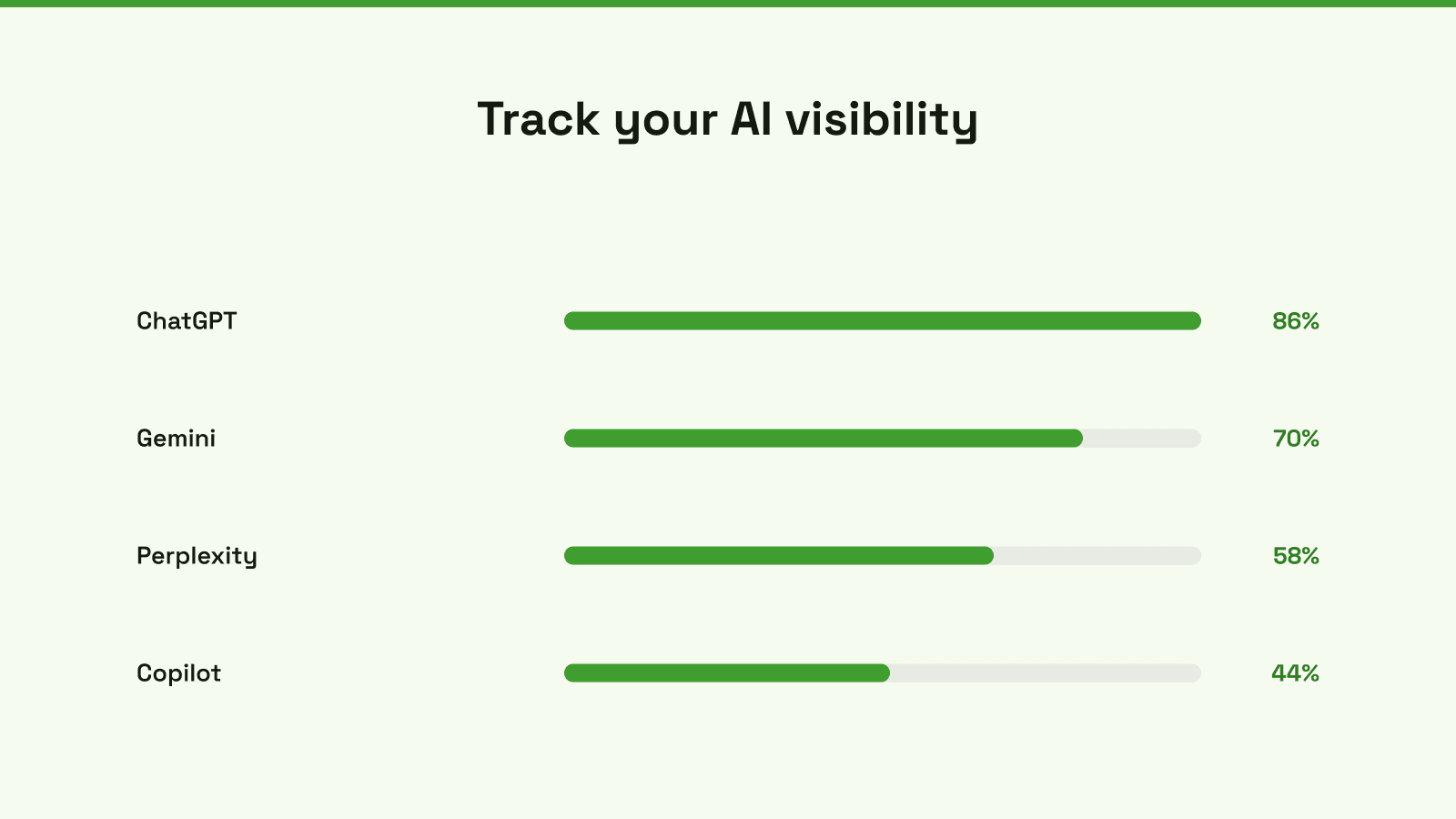
They ask broad prompts like “best skincare brands” or “top Shopify stores.” Those prompts are noisy and rarely map to actual buying behavior. A better measurement loop starts with purchase-intent prompts, compares visibility against competitors, and then checks which pages AI crawlers already care about.
One technical workflow stands out because it forces discipline. A recommended audit loop is to run 1,000–10,000 AI prompts across target topics, identify where competitors are visible and you aren't, then use log-file analysis to prioritize pages that already receive AI crawler activity (seoClarity's AI search optimization workflow).
Test with buying prompts, not vanity prompts
If you sell hydration packs, don't start with “best fitness brands.”
Start with prompts closer to what shoppers ask:
- Trail-running specific prompts such as requests for lightweight hydration packs for long runs
- Constraint-based prompts that include budget, shipping region, or intended use
- Comparison prompts where buyers ask for alternatives to known products
- Policy-aware prompts involving delivery timing, returns, or gifting needs
This exposes a more useful truth. AI visibility isn't one ranking. It's a pattern across scenarios.
Track whether your products appear, how they are described, whether key policies are included correctly, and which competitors repeatedly take your place.
Use crawler activity to choose what to fix first
Not every page deserves immediate effort.
When bot logs show repeated AI crawler activity on a subset of pages, that's a strong operational signal. Improve those pages first. Add fresher copy, answer blocks, FAQs, examples, and stronger structured detail where you already have evidence of AI interest.
That usually beats rewriting random blog posts no one is retrieving.
A practical review queue often looks like this:
- Pages frequently visited by AI bots
- Product and category pages tied to high-margin demand
- Policy pages that influence recommendation trust
- Comparison or buyer-guide content where competitors are cited more often
Tie AI visibility back to commerce signals
AI mentions matter. Business outcomes matter more.
You won't always get a neat attribution path, so look for directional patterns:
| Signal | What to watch |
|---|---|
| AI mentions | Whether your products appear more often across target prompts |
| Brand framing | Whether AI describes your store accurately |
| Direct traffic | Whether direct sessions rise after improved AI exposure |
| Branded search | Whether shoppers search your brand after seeing recommendations |
| Assisted conversion behavior | Whether more users arrive already narrowed to a specific product |
Many teams go wrong by expecting AI visibility to look exactly like classic organic reporting. It won't. Some users will click. Some will return later through branded search. Some will convert after seeing your product named in a conversation elsewhere.
Measurement rule: Track recommendation presence, description accuracy, and downstream demand signals together. Looking at only one of those gives you a distorted read.
Frequently Asked Questions About AI Optimization
Does AI optimization replace SEO
AI optimization changes what strong SEO has to produce.
Google SEO still matters because your store has to be crawlable, indexable, and technically clean. AI systems add a second requirement. Your product pages, policy pages, and support content must be easy to extract, compare, and cite. For DTC brands, that shifts the target from page rankings alone to product recommendation readiness.
A page can rank and still fail here. If an assistant cannot confidently answer who the product is for, what it costs, when it ships, or how returns work, your product is less likely to be recommended.
Is Shopify Catalog enough on its own
Usually, no.
A catalog feed gives AI systems the basics. It does not give them enough context to recommend products in real shopping conversations. Shoppers ask fit, use-case, compatibility, shipping, return, and comparison questions. If that context only exists in scattered app blocks, hidden tabs, or vague copy, AI assistants have less to work with.
That is why product discovery work still happens on the store itself. Strong PDPs, clear policy pages, and useful category content give AI more than a SKU and a price. They give it reasons to choose your product over a similar one.
How long does it take to see results
The timeline depends on how clean your store data already is.
Brands with consistent product attributes, visible policies, and usable schema can often see improvements faster in prompt testing. Brands with messy variant data, outdated FAQs, and conflicting shipping or return language usually spend the first phase fixing trust problems, not gaining visibility.
Freshness also affects recommendation confidence. Add visible update dates where accuracy matters, and keep your structured data aligned with what the page says. If your return window changed three months ago but your schema or FAQ still shows the old version, AI systems have a good reason to avoid citing you.
What should a DTC brand do first
Start with the pages that decide whether an assistant can recommend a product without hesitation.
- Product pages that are missing key attributes, use vague benefit copy, or show offer data that conflicts with schema
- Shipping pages that bury timing, thresholds, or exceptions in hard-to-summarize text
- Return policy pages that exist, but do not state the rules in plain language
- Category and comparison pages that fail to connect products to specific buying intents
This is the practical shift. AI optimization is not brand storytelling first. It is making your products easy to retrieve, easy to compare, and safe for an assistant to recommend.
If your Shopify store needs a cleaner way to expose products, prices, shipping rules, and return policies to AI shopping assistants, Shoptank is one option to evaluate. It's built to help merchants generate structured store data, publish AI-readable catalog information, and monitor how their brand appears across AI platforms.
Want to track your progress against competitors? Compare the options in our Ahrefs for Shopify guide.