Ecommerce Platform Comparison 2026: Which One Is Best?
Most advice on the best ecommerce platform is already outdated.
The usual rankings still compare theme quality, app stores, payment options, and ease of setup. Those factors still matter. They just don't answer the question founders need to answer in 2026: will this platform make your catalog understandable to AI-driven product discovery, or will it leave you invisible where more shoppers are starting their journey?
That shift isn't theoretical. BigCommerce notes an underserved angle in platform selection: most guides still ignore structured, up-to-date data for AI crawlers, even as 60% of consumers are shifting from Google to conversational AI for product discovery in its cited industry framing, and mainstream “best platform” roundups rarely evaluate AI accessibility at all (BigCommerce on ecommerce platforms and AI visibility gaps).
So the old question, “What's the best ecommerce platform?” isn't precise enough.
A better question is this: which platform fits your operating model, gives you acceptable total cost, performs well under load, and can expose your products, pricing, policies, and shipping logic in ways both humans and AI systems can reliably understand? If a platform looks great in a demo but fails on that last part, it can still be the wrong choice.
Here's a practical view of the field before we go deeper.
| Platform | Best fit | Main strength | Main trade-off | AI visibility readiness |
|---|---|---|---|---|
| Shopify | DTC brands, fast-moving teams | Fast launch, polished ecosystem | App dependency can grow quickly | Often needs added structured-data work |
| BigCommerce | Scaling mid-market brands | Strong built-in commerce depth | Less intuitive for some lean teams | Better for teams that want more control over data handling |
| WooCommerce | WordPress-native, technical operators | Deep flexibility | Maintenance burden is real | Depends heavily on implementation quality |
| Adobe Commerce | Complex enterprise retail | Heavy customization and control | Expensive and resource-intensive | Powerful, but only if the team maintains structure well |
| Wix / Squarespace | Smaller catalog brands | Simplicity and speed | Can hit limits as complexity grows | Fine for basics, weaker for advanced AI discovery workflows |
Table of Contents
- Why Your 'Best Ecommerce Platform' Search Is Flawed
- The Core Ecommerce Platform Contenders for 2026
- A Modern Framework for Choosing Your Platform
- The Critical Role of AI Visibility in Ecommerce
- Recommended Platforms by Business Model
- Evaluating the True Total Cost of Ownership
- How to Future-Proof Your Ecommerce Stack
Why Your 'Best Ecommerce Platform' Search Is Flawed
The search is flawed because it assumes there's one universal winner.
There isn't. A platform that works for a single-brand skincare store can be a poor fit for a multi-region retailer with layered compliance rules. A platform that feels perfect for a founder on day one can become expensive and brittle once that business adds subscriptions, localization, wholesale pricing, and multiple storefronts.
The bigger problem is that most “best ecommerce platform” advice still measures the wrong things. It tends to reward what's easy to compare in a chart: theme libraries, drag-and-drop editing, checkout options, and app counts. Those are visible features. They're not the whole job.
The old comparison model misses the new discovery layer
Buyers don't only browse category pages and search results anymore. They ask AI tools for product recommendations, comparisons, policy clarifications, and brand suggestions. That changes platform selection because AI systems don't “see” your store the way a shopper does. They rely on structured, current, machine-readable signals.
If your product data is inconsistent, your shipping logic is unclear, or your return rules live in unstructured fragments across pages, AI systems may not surface your store well, even if your site design is excellent.
Practical rule: The best ecommerce platform is no longer the one with the nicest admin. It's the one that helps your business stay legible across search, shopping feeds, operations, and AI discovery.
“Best” depends on what breaks first in your business
In practice, platform choice usually fails in one of four places:
- Operational strain: Teams outgrow the workflow and start patching core processes with apps.
- Data rigidity: Merchants can't represent products, variants, bundles, or policies cleanly enough.
- Performance drag: Pages slow down, server responses lag, and checkout friction rises.
- Discovery gaps: The store exists online, but key systems can't interpret it reliably.
That last failure mode is the one most buyers still underestimate.
If you're evaluating platforms the old way, you're likely choosing for storefront aesthetics and setup speed. You should be choosing for commercial clarity, technical control, and future discoverability. That's a different decision.
The Core Ecommerce Platform Contenders for 2026
The market isn't getting smaller or simpler. MarketsandMarkets projects the global ecommerce platform market at USD 9.08 billion in 2025, rising to USD 16.51 billion by 2030 at a 12.7% CAGR, with key players including Shopify, BigCommerce, Adobe, Wix, Squarespace, and WooCommerce (MarketsandMarkets on the ecommerce platform market).
That growth matters because it reflects a crowded field where most platforms are good enough to launch on. The key question is fit.
Shopify for speed and brand execution
Shopify is still the default recommendation for a reason. It's fast to launch, easy to train on, and strong for direct-to-consumer brands that care about creative, campaign velocity, and a low-friction operating model.
It works especially well when a team wants to move without a large engineering function. Merchants can launch quickly, test offers, add channels, and keep daily merchandising work inside a clean interface.
Where Shopify starts to pinch is complexity. Once a brand layers on subscriptions, advanced merchandising rules, custom B2B workflows, or region-specific logic, the app stack can become part of the platform itself.
BigCommerce for scaling operators
BigCommerce tends to make more sense for merchants who want stronger native commerce capability and less dependence on bolt-ons. It often appeals to teams that already know their catalog and fulfillment rules are going to get more demanding.
It's not always the easiest option for a lean founder who wants to launch over a weekend. But it can be a more comfortable fit for operators who care about governance, data structure, and reducing how much commerce logic lives in third-party apps.
WooCommerce for control with responsibility
WooCommerce is still a serious contender if you already live in WordPress or you need flexibility that hosted systems can't easily match. It can be the right call for content-heavy brands, specialist catalogs, and technically confident teams.
The trade-off is obvious to anyone who has run it at scale. You own more of the stack. That means more control, but also more maintenance, more plugin discipline, and more risk if your implementation is loose.
A flexible platform doesn't save a weak operation. It exposes it faster.
Adobe Commerce for enterprise complexity
Adobe Commerce belongs in the conversation when the business has enterprise-grade requirements from the start. Large catalogs, deep integrations, custom account structures, and bespoke workflows can justify the overhead.
But that overhead is real. Adobe isn't a casual choice. Teams need budget, technical leadership, and a clear reason for choosing power over simplicity.
Wix and Squarespace for smaller commerce footprints
Wix and Squarespace can work well for businesses where ecommerce is important but not the entire operating core. Think curated assortments, strong visual branding, and relatively straightforward catalog logic.
They're less convincing once the store becomes operationally dense. At that point, simplicity can become a ceiling.
A Modern Framework for Choosing Your Platform
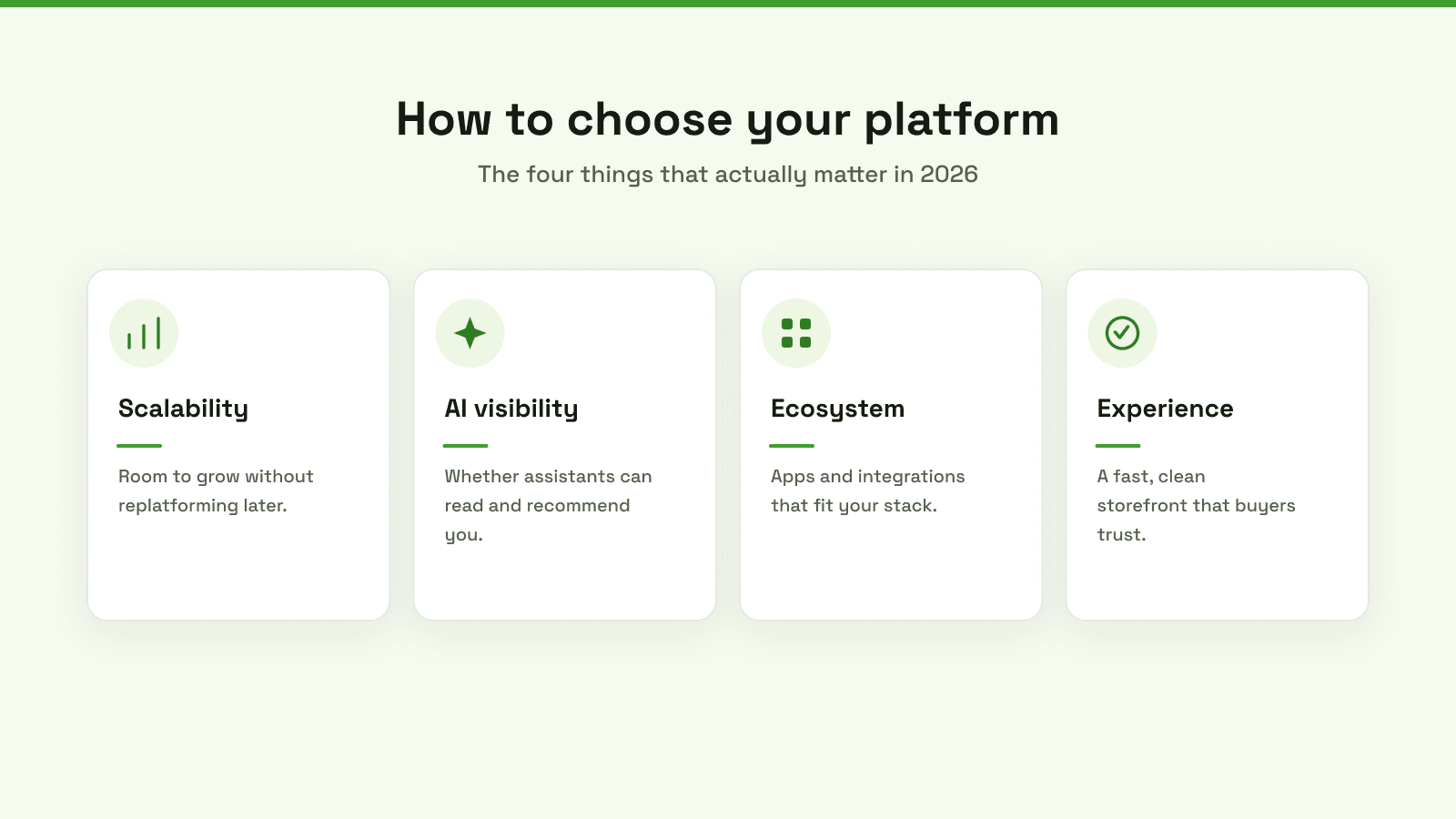
The best ecommerce platform decision gets clearer when you stop comparing features and start testing four pillars: total cost, technical agility, performance plus discoverability, and exit flexibility.
Cost is more than the monthly plan
A low entry price often hides a high operating price. Teams add paid themes, paid apps, paid connectors, developer hours, and process workarounds. By then, the platform is no longer cheap. It's just fragmented.
The right question isn't “What does this plan cost?” It's “What does this business need to spend to run cleanly on this platform?”
Technical agility decides how fast you can adapt
Some platforms are easy to launch but harder to bend. Others are slower to implement but easier to shape around real business rules.
Ask practical questions:
- Can your team model your catalog cleanly? Bundles, variants, regional availability, and policy differences matter.
- Can you integrate without duct tape? ERP, PIM, returns, search, subscriptions, and analytics all need stable connections.
- Can your team ship changes safely? Every new app or custom patch creates another failure point.
A useful reference point is to look at how merchants are thinking about AI product recommendations in ecommerce operations. The platform doesn't need every AI feature built in, but it does need clean enough data and integration patterns to support them.
Performance and discoverability now sit together
Performance is still non-negotiable. Magestore's 2026 benchmark cites an average page load time of 5.3 seconds and server response time of 0.9 seconds, while platforms exceeding those thresholds often see bounce rates near 41% (Magestore ecommerce website benchmarks).
That's not just a frontend issue. Slow stores create operational drag, weaker engagement, and lower conversion potential. But performance now sits beside discoverability. A fast store that AI systems can't interpret still leaves money on the table.
Migration matters before you need it
The final pillar gets ignored until the business is already in pain.
Look at the exit path before you commit:
| Question | Why it matters |
|---|---|
| Can you export product and customer data cleanly? | Prevents lock-in |
| Can you replace apps without breaking core workflows? | Reduces platform fragility |
| Can the platform support your next channel or region? | Avoids forced replatforming |
| Can your team document custom logic clearly? | Makes future migration possible |
Most bad platform decisions aren't bad on day one. They become bad when the business changes faster than the stack can.
The Critical Role of AI Visibility in Ecommerce
Many still treat AI visibility like a future feature. It's already a live commerce issue.
Elementor's ecommerce roundup says the AI-enabled ecommerce market is valued at $8.65 billion in 2025 and is expected to more than double by 2032, while AI-driven personalization now powers 91% of consumer preferences (Elementor ecommerce statistics). That doesn't just signal better recommendation widgets. It signals a broader shift in how product discovery and purchase influence work.
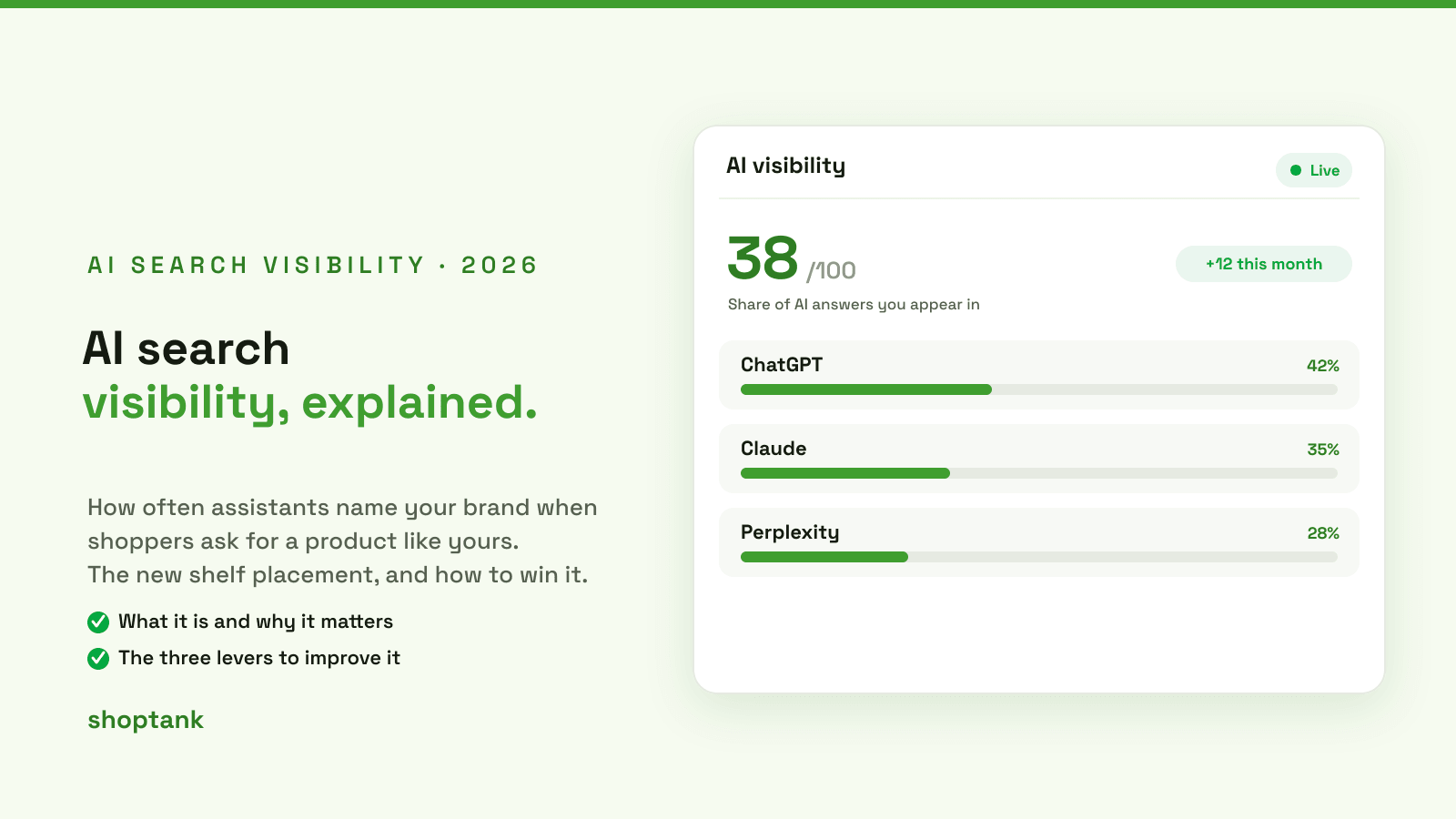
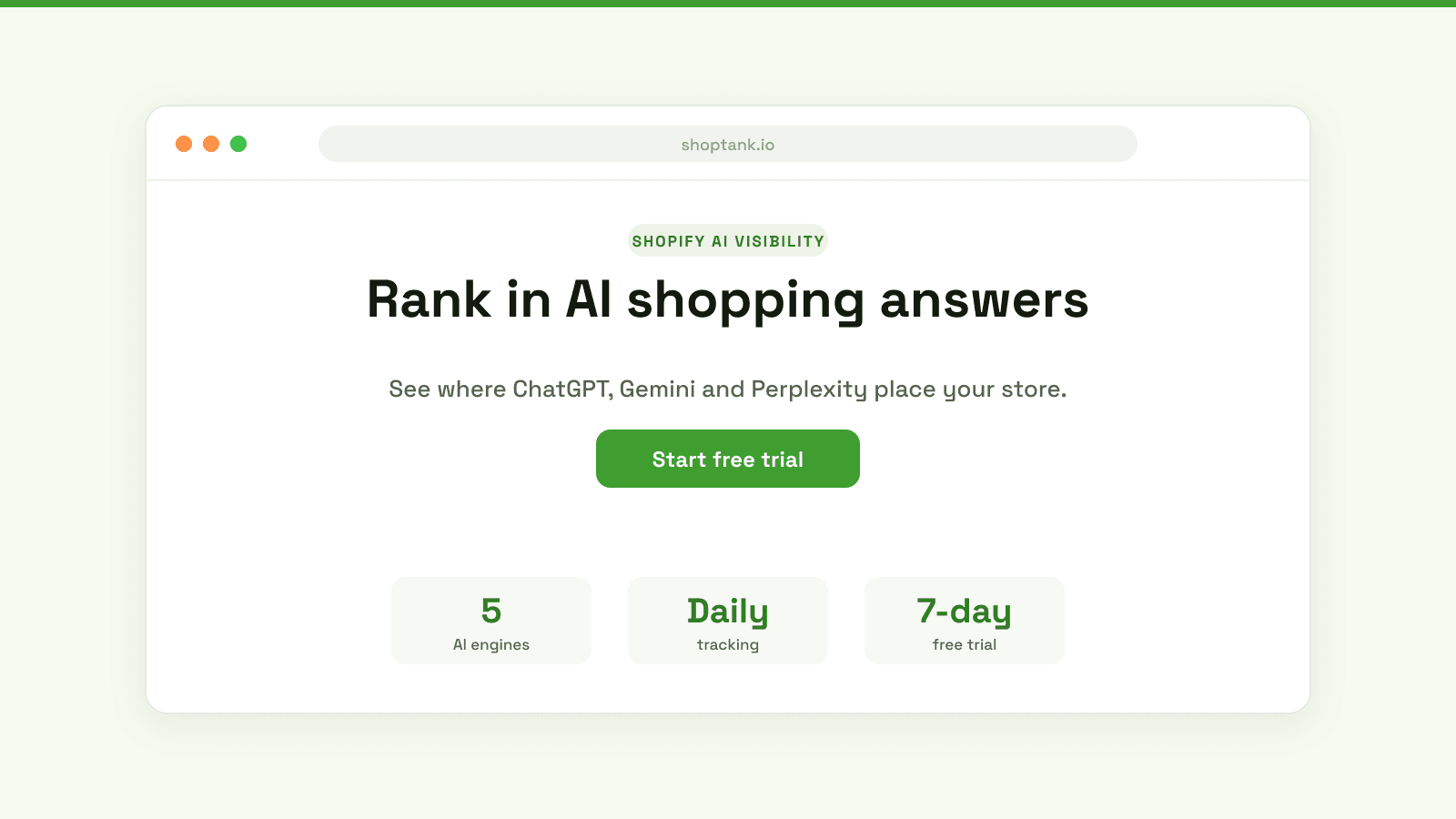
To make this concrete, here's what AI-focused visibility tooling looks like in practice.
Why Google visibility no longer guarantees discovery
A store can rank well in traditional search and still be poorly represented in conversational AI.
That's because AI systems don't just index pages. They infer product facts, compare options, summarize return rules, interpret shipping constraints, and decide whether they trust the store data enough to mention it. If the underlying data is incomplete or inconsistent, your store becomes harder to recommend.
This is why standard platform reviews now miss a key decision criterion. They still ask whether your site is easy to edit. They don't ask whether an AI assistant can clearly understand your catalog and store policies.
Your homepage is written for humans. Your structured data is written for machines. In 2026, you need both.
What AI systems need from your store
AI visibility usually comes down to a few practical requirements:
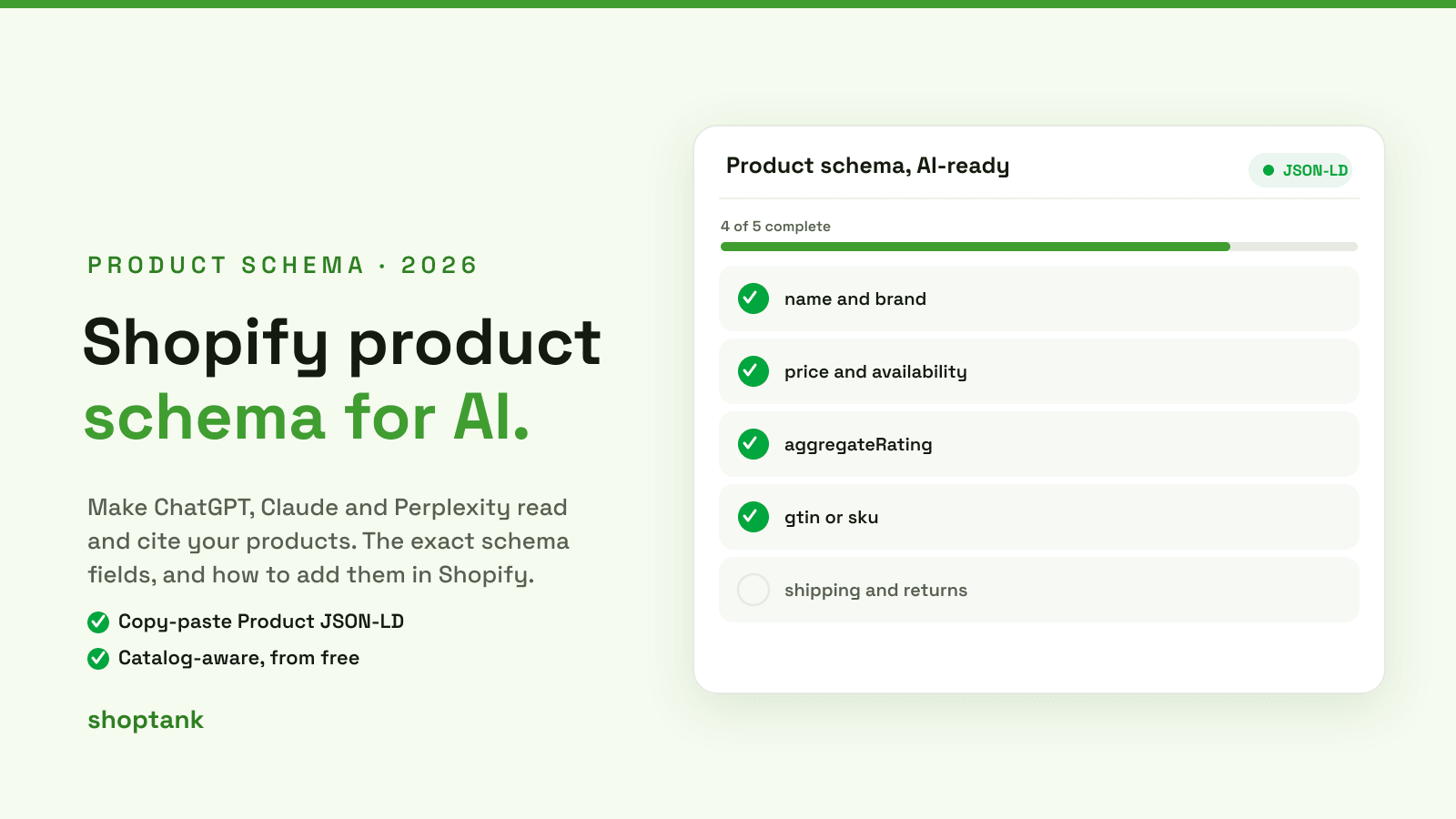
- Structured product data: Titles, variants, pricing, availability, and category context need to be explicit.
- Policy clarity: Shipping, returns, and service terms should be machine-readable, not buried in scattered prose.
- Current information: AI systems are far less useful when they ingest outdated product or policy details.
- Consistent markup: Schema and AI-oriented documentation reduce ambiguity.
For teams trying to understand the mechanics, a useful primer is this guide on how to optimize for AI search in ecommerce.
Why this affects revenue, not just SEO hygiene
When shoppers ask an AI assistant for “the best travel backpack under a specific price,” “a clean skincare routine for sensitive skin,” or “a store with clear return policies,” your storefront design isn't what answers first. Your data does.
That makes AI visibility a top-of-funnel issue.
A merchant who ignores this can still run paid media, improve product pages, and tune checkout. But they may miss discovery entirely if AI systems don't confidently surface their brand in the first place.
A short walkthrough helps frame the shift:
The practical takeaway is simple. When comparing the best ecommerce platform, stop treating AI visibility as an add-on. Treat it like product feed health, schema quality, or site speed. It belongs in the core evaluation, not in a wishlist for later.
Recommended Platforms by Business Model
The best ecommerce platform depends less on headline features and more on how the business makes money. That's where most broad rankings fail. They compare tools in the abstract, while merchants operate in constraints.
The modern DTC brand
For a modern direct-to-consumer brand, Shopify is usually the best fit.
It's strong when the business needs speed, merchandising control, campaign execution, and a storefront that marketing teams can readily operate without filing tickets for every change. Product launches, bundles, landing pages, influencer drops, and seasonal edits are easier to manage when the admin is clean and the ecosystem is mature.
The risk isn't launch quality. It's overreliance on apps for every non-standard need. A DTC team can end up with a visually polished store and a messy operating backend if they don't control app sprawl and data consistency.
The high-volume dropshipper
For a high-volume dropshipping operation, BigCommerce often deserves more consideration than it gets.
This model puts pressure on catalog management, supplier logic, shipping rules, and margin protection. The teams that do best here usually value operational control over cosmetic flexibility. They need a system that can handle catalog movement without turning every workflow into an app chain.
That doesn't mean Shopify can't work. It can. But dropshipping businesses with more demanding operations often benefit from a platform choice that reduces dependence on workaround architecture.
Operator takeaway: If your margin depends on process discipline, choose the platform that reduces exceptions, not the one with the prettiest theme demo.
The enterprise retailer
For an enterprise retailer, the answer usually narrows to Adobe Commerce or BigCommerce, with Shopify Plus in the broader conversation when the organization prioritizes speed and ecosystem support over deeper customization.
This isn't just about company size. It's about complexity. Enterprise teams deal with layered permissions, international storefronts, approval chains, negotiated pricing, and long integration maps. The wrong platform creates internal friction before it creates customer friction.
Use this rough lens:
| Business condition | Better fit |
|---|---|
| Deep customization and internal systems complexity | Adobe Commerce |
| Strong commerce capability with less implementation weight | BigCommerce |
| Brand-led execution with a preference for ecosystem velocity | Shopify |
The niche marketplace or specialist catalog
For a niche marketplace, specialist parts catalog, or content-rich expert store, WooCommerce can be the smartest option if the team is technically capable.
That kind of business usually needs unusual product relationships, richer editorial context, and tighter control over content structure. WooCommerce works when the business wants to shape the store around the catalog, not the catalog around the store.
The warning is straightforward. If no one on the team owns maintenance quality, plugin governance, and platform hygiene, WooCommerce can become expensive in labor even when software costs look modest.
A fast summary helps:
- Choose Shopify when brand speed and team usability come first.
- Choose BigCommerce when operational depth matters more than startup simplicity.
- Choose Adobe Commerce when complexity is native to the business, not an edge case.
- Choose WooCommerce when flexibility is the advantage and the team can support it.
The best ecommerce platform isn't the one widely recommended. It's the one that matches how your business breaks under pressure.
Evaluating the True Total Cost of Ownership
Sticker price is where weak platform analysis begins.
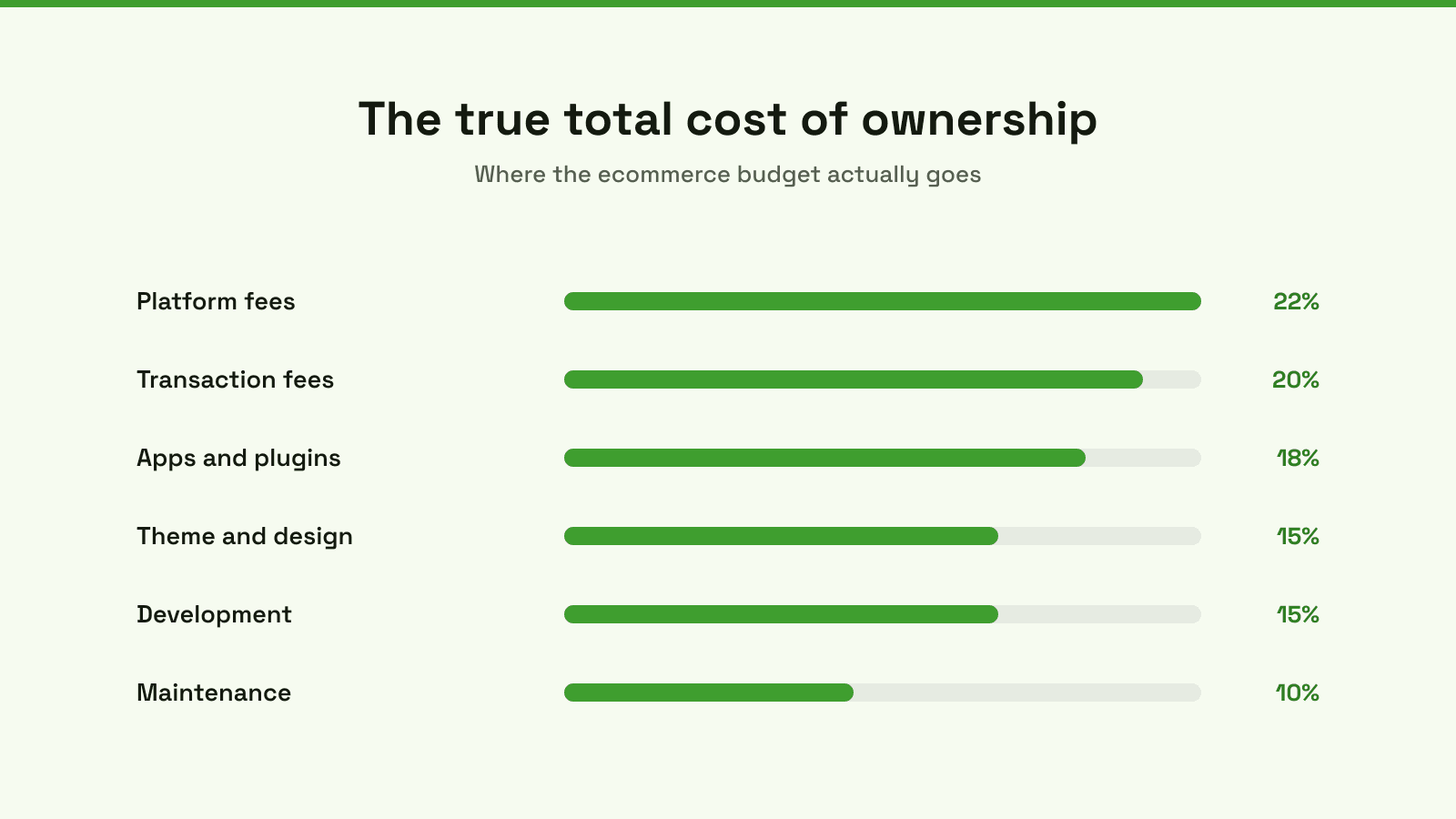
Primary cost arises from the stack around the subscription: app dependencies, customization work, maintenance, payment complexity, content operations, and the labor required to keep everything working when the catalog and organization grow.
The visible costs everyone notices
These are the easy ones:
- Platform subscription: The plan itself.
- Theme and design work: Either premium themes or custom frontend work.
- Payment and checkout tooling: Especially when checkout logic gets more specialized.
- Apps and plugins: Search, reviews, subscriptions, bundles, returns, analytics, localization.
Most founders budget for these. The bigger miss is that they budget for them as line items, not as a system. A platform with a modest monthly fee can still become the more expensive choice if it requires too many paid layers to feel complete.
The hidden costs that change the decision
Platform economics start to diverge.
Salesforce's small business platform discussion highlights a gap that most rankings skip: managing multiple stores, translation schemas, and varying return policy structures can double operational costs compared to flat-rate competitors, which leaves many merchants unprepared for the reality that the best platform for one store may be the worst for a multi-store setup (Salesforce on best ecommerce platforms for small business).
That tracks with what operators see in the field. Costs climb when teams need to duplicate merchandising effort, manage separate rule sets, reconcile inconsistent app behavior across stores, or maintain region-specific compliance manually.
The expensive platform isn't always the one with the highest invoice. It's the one that makes your team repeat work.
A better budgeting approach
When evaluating the best ecommerce platform, build a working model around these questions:
- What must be native, and what will require add-ons?
- How many critical workflows depend on third parties?
- How much developer support will changes require?
- What happens when you add a new store, region, or policy layer?
- How hard is it to remove tools you no longer want?
Then test cost against commercial performance, not just accounting neatness. Salesforce notes that global ecommerce conversion rate hovers around 3%, and checkout friction often shows up in abandonment rather than in obvious complaints (Salesforce commerce metrics and conversion benchmarks).
That's why total cost of ownership should include the cost of friction. If the cheaper platform creates a slower store, clumsier checkout, or more manual operations, the budget advantage can disappear quickly.
How to Future-Proof Your Ecommerce Stack
Future-proofing doesn't mean predicting every channel change. It means building a stack that can absorb change without forcing a rewrite of the business.
That starts with one mindset shift. Don't choose a platform as an identity. Choose it as infrastructure.
Choose for adaptability, not platform loyalty
The strongest ecommerce setups are rarely the ones with the longest feature lists. They're the ones where teams can change product structure, swap supporting tools, expand channels, and document business logic clearly.
A future-proof stack usually has these traits:
- Clean data ownership: Product, policy, and customer data aren't trapped in scattered apps.
- Documented workflows: The business knows how pricing, promotions, fulfillment, and returns work.
- Replaceable components: Search, personalization, analytics, and merchandising tools can change without wrecking the storefront.
- Operational discipline: The team reviews what's been added and what's now redundant.
Treat AI readiness as infrastructure
AI visibility now belongs in the same category as site speed, schema quality, and feed hygiene. It's not a bonus layer for innovation teams. It's part of how products become discoverable.
For Shopify merchants especially, it helps to understand how Shopify AI catalog workflows function in practice. The important lesson isn't that one platform magically solves AI discovery. It's that merchants need systems that keep catalog and policy data structured, current, and legible across new interfaces.
The best ecommerce platform in 2026 is the one that gives you room to evolve. It should support the business you have today, but it also needs to survive the next shift in discovery, merchandising, and customer behavior without pushing you into a full rebuild.
Choose the platform that keeps your operation clear, your data usable, and your storefront understandable to both buyers and machines.
If your store runs on Shopify and you want AI assistants like ChatGPT, Perplexity, Gemini, Claude, and Copilot to understand your products, pricing, shipping, and policies, take a look at Shoptank. It helps merchants generate AI-ready catalog signals, improve structured visibility, and monitor how their brand appears across leading AI discovery platforms.