How Supplement Shopify Stores Use Shoptank for AI Visibility
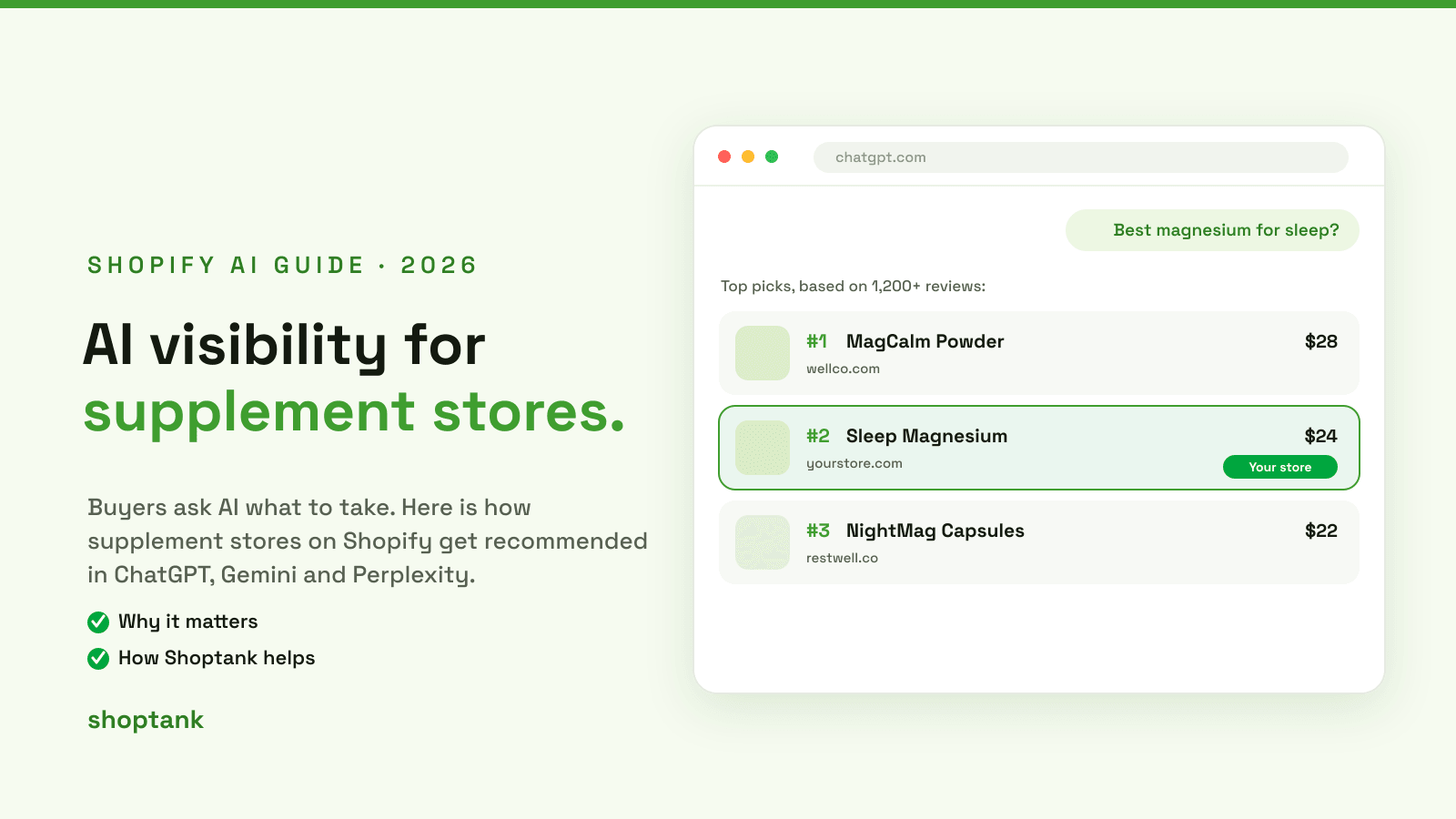
Supplement shopping is question-led. Instead of browsing, people ask: what helps me sleep, which protein is best for beginners, what should I take for energy. More and more, they ask an AI, and the assistant answers with a short list of products and the stores that sell them. If your store is not on that list, the sale quietly goes to a competitor. Here is how supplement stores on Shopify use Shoptank to get into those answers.
Key takeaways
- Supplement buying is use-case led, so shoppers ask AI things like best magnesium for sleep, then buy from the store it names.
- Winning depends on clean product data and categories plus trust signals, which supplement catalogs often lack.
- Shoptank shows which of those queries you win, who beats you, and drafts the fixes. It starts free.
On this page
- Why AI visibility matters for supplements
- The queries your buyers ask
- How supplement stores use Shoptank
- The playbook
Why AI visibility matters for supplements
Two things make supplements a strong fit for AI visibility. First, the buying is question-led, so the assistant's answer is often the whole shopping trip. Second, the category is crowded and trust-sensitive, so a shopper is happy to take a recommendation rather than compare fifty products. That means the store the assistant names has an outsized advantage, and the stores it does not name are invisible no matter how good their products are.
The queries your buyers ask
Supplement queries are specific. A shopper does not ask for supplements, they ask for a magnesium for sleep, a vegan protein for muscle, electrolytes for runners. Each of those is a separate question with its own answer, so your visibility is really a set of positions, one per query.

The job is to know which of your real buyer queries you win, and which a competitor takes. That is exactly what a tracker is for.
How supplement stores use Shoptank

Shoptank tracks how your store ranks for those queries across ChatGPT and Claude, shows which brands are recommended instead of you, and turns the gaps into fixes. For a supplement catalog those fixes are usually about clarity: making each product's form, ingredients and use case complete in the data, categorizing correctly across a large catalog, and publishing factual product information in a knowledge base assistants can read. Because supplement stores tend to have many products and variants, the taxonomy and metafields work matters even more than usual.
The playbook

- Track your ingredient and benefit queries. Use the exact questions buyers ask.
- See which brands AI recommends instead. Note who wins which query.
- Clean up product data and categories. Complete form, ingredients, use case, and correct taxonomy.
- Publish factual ingredient and use information. Clear, accurate answers, no health claims you cannot back up.
- Earn reviews and cited sources. Trust signals matter in a sensitive category.
- Monitor your rank per query. Watch corrected products move from missing to recommended.
To go deeper, see why ChatGPT skips a store, how to track your rank in ChatGPT, and the best AI visibility tools for Shopify.
Your buyers are already asking AI what to take. The only question is whether it names your store. On Shopify, you can find out free.