The Citation Loop: How to Get Your Shopify Store Cited by ChatGPT
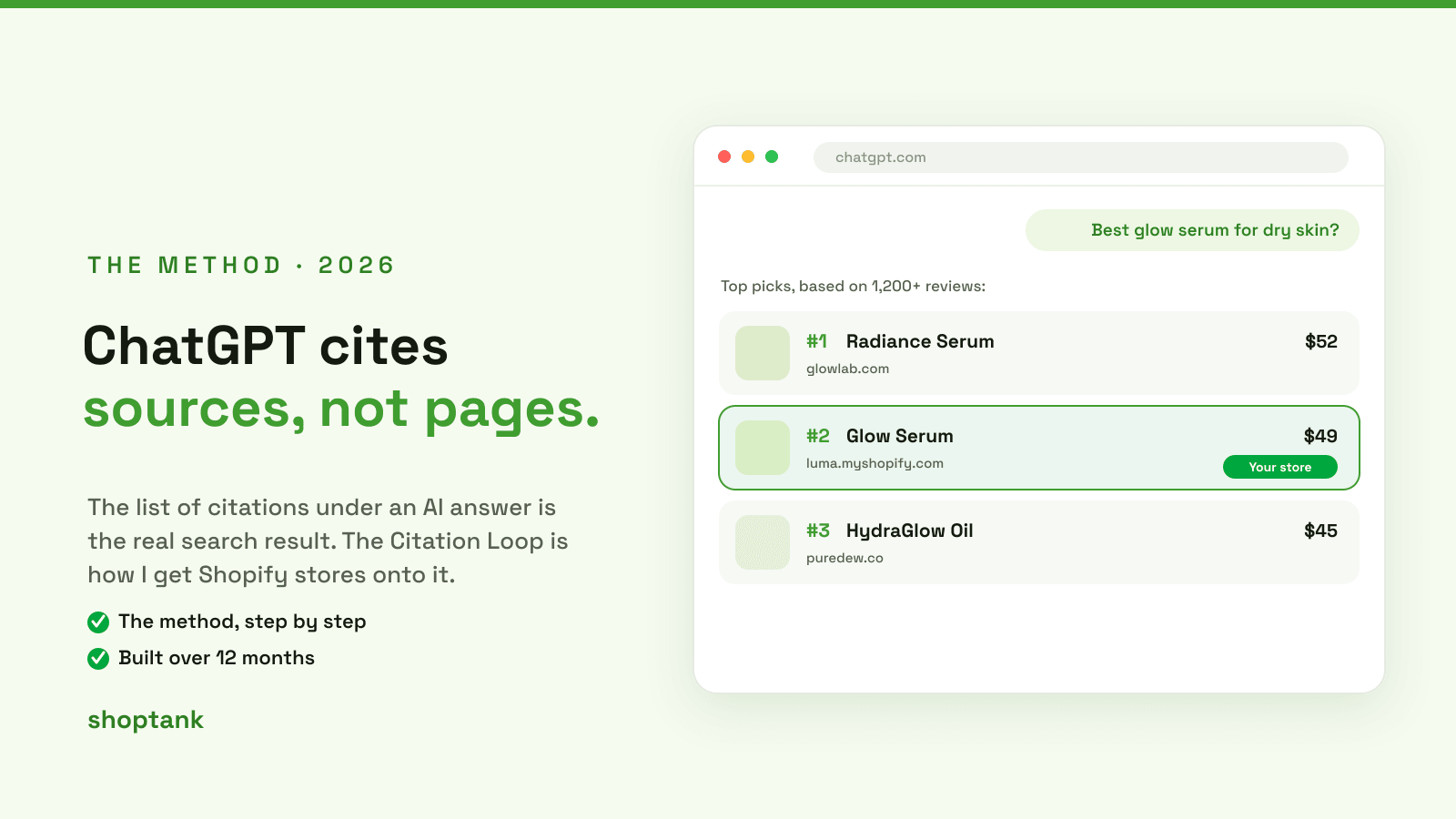
ChatGPT does not rank pages. It cites sources.
I spent 12 months learning what that one line means for a Shopify store, and it changed how I get found. Google returns a ranked list of pages, so SEO optimizes the page. An AI assistant does something else. It retrieves a set of source URLs, then writes an answer from them. The answer is the output. The list of citations under it is the actual search result.
Once I saw that, the goal stopped being write better content. It became narrower and more useful. Find the small, finite list of URLs the models already pull from in your category, and get onto that list. I named that process the Citation Loop. Here is exactly how I run it.
Key takeaways
- ChatGPT does not rank pages, it cites sources. The citation list under the answer is the real search result.
- A category's citation set is small: 12 to 20 domains, finite, and fully public.
- 40 buying questions is 40 separate routes into your store, none of them paid.
- The loop repeats every 14 days, because answers move. That is why I built Shoptank to run it.
On this page
- The one difference that changes everything
- Why this beats SEO
- The Citation Loop, step by step
- What the citation set looks like
- Why it works
- Why I built Shoptank to run it
The one difference that changes everything
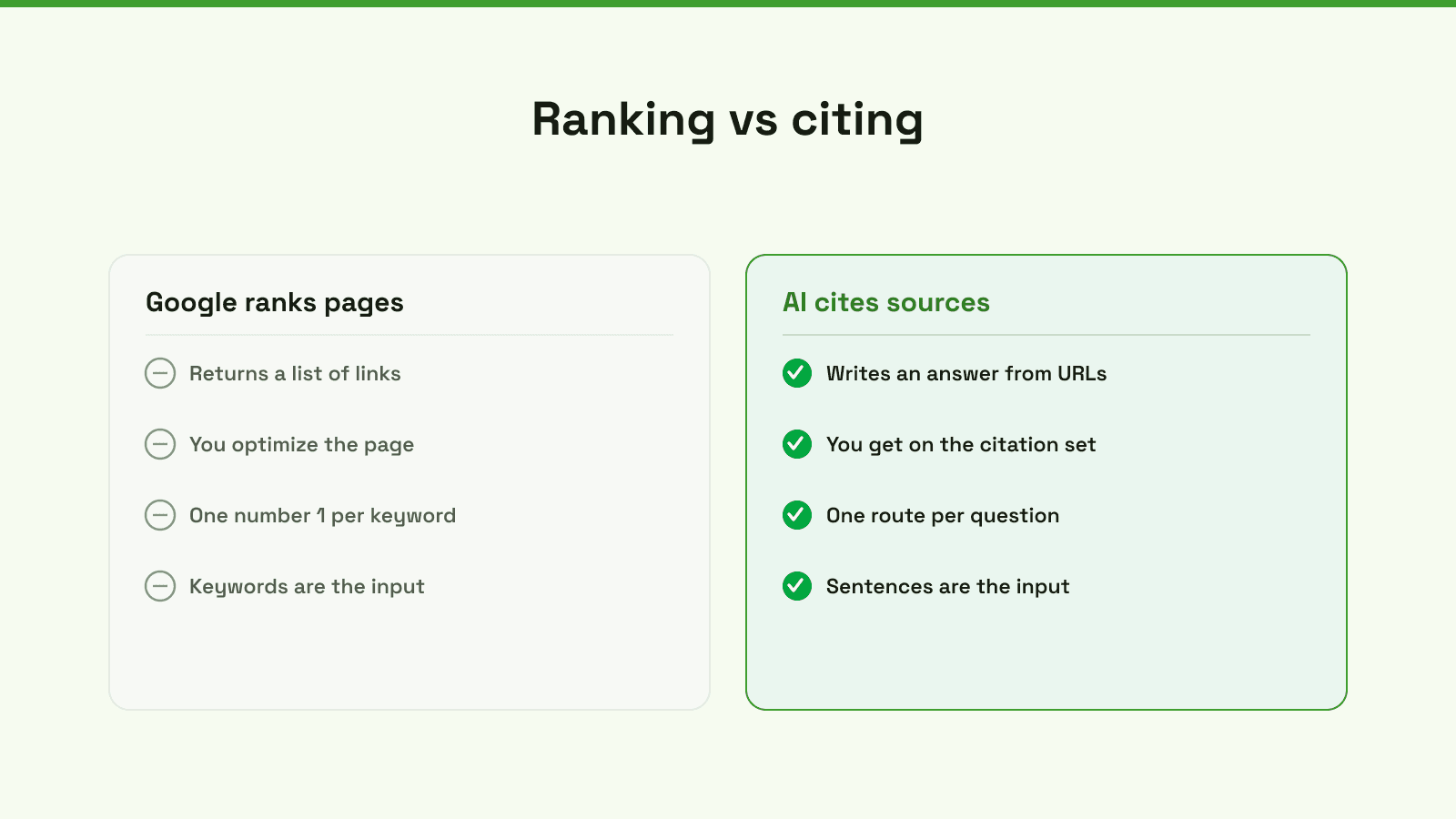
Google gives you a page of links and one number 1 position per keyword. You fight for that page. An AI assistant retrieves 5 to 15 source URLs for a question, then writes a single answer from them. You are not fighting for a page anymore. You are fighting to be one of the sources it pulls. That is a different game with a different unit of victory, and almost nobody in ecommerce is playing it yet.
People type keywords into Google and sentences into models. That is the tell. If you are still building keyword lists, you are optimizing for the wrong input.
Why this beats SEO
Here is the argument that made me build a company around this. Google gives one number 1 position per keyword. The Citation Loop gives one path per question. Pull 40 buying questions and you have 40 separate routes into the store, none of them paid. You do not have to win a single competitive keyword. You have to be a cited source across 40 questions, and every one you win is a door a buyer walks through.
The Citation Loop, step by step
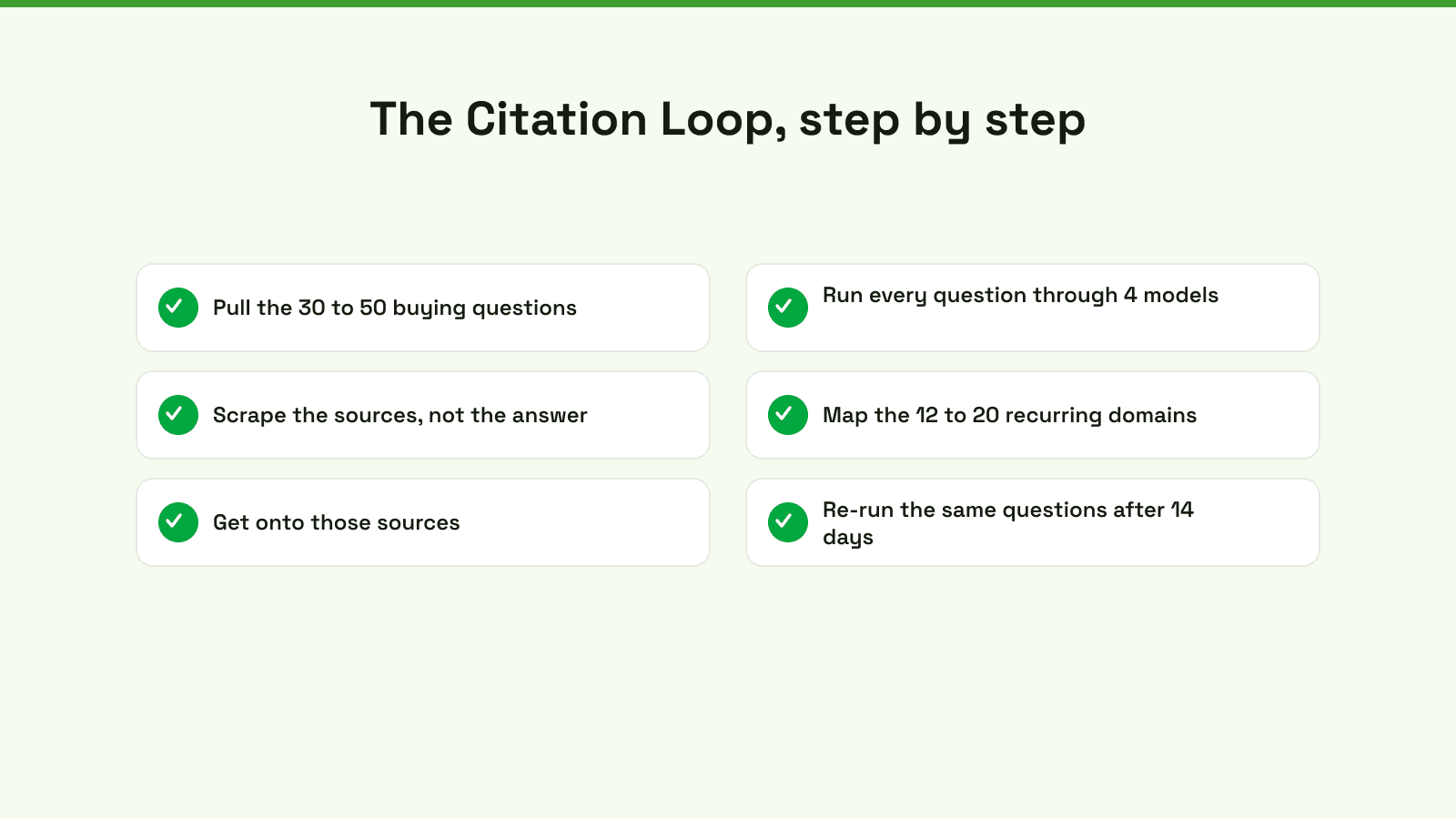
Six steps. I run them in this order.
1. Pull the buying questions
Not keywords. Questions. The 30 to 50 things a real buyer types into a model when they are close to purchase. Best waterproof work jacket for winter. Brand A vs brand B. Where to buy X in Germany. Is X worth the money. These are sentences, and they are the input the whole method runs on.
2. Run every question through every model
ChatGPT, Claude, Perplexity, Gemini. I run all four. The same question produces four different answers built on four different source lists. One model is a sample of one, and a sample of one gives you a wrong map.
3. Scrape the sources, not the answer
This is the step everyone skips, and it is the whole method. Every AI answer is assembled from roughly 5 to 15 cited URLs. In my runs those are listicles, Reddit and forum threads, review sites, comparison pages, and small niche blogs. Rarely the brand's own homepage. I log the URLs, not the prose. The prose is not the result. The URLs are.
4. Map the overlap
Run 30 questions and the same 12 to 20 domains keep reappearing across them. That recurring set is the citation set for the category.
5. Get onto those sources
Three routes, in rough order of speed. First, get added to the listicles and comparison pages that are already being cited, by contacting the publisher. Second, get mentioned inside the threads and community discussions that are being cited. Third, publish the same shape of content on your own domain, so the model has a reason to retrieve you directly. Shape means format. If the cited pages are best X for Y comparison pages with tables, that is what gets retrieved, not a brand story page.
6. Re-run the identical questions after 14 days
Same questions, same wording, same models. I compare the mention count on day 0 against day 14. That comparison is the measurement, and it is why this is a loop and not a checklist. Answers move, so the cycle repeats.
What the citation set looks like
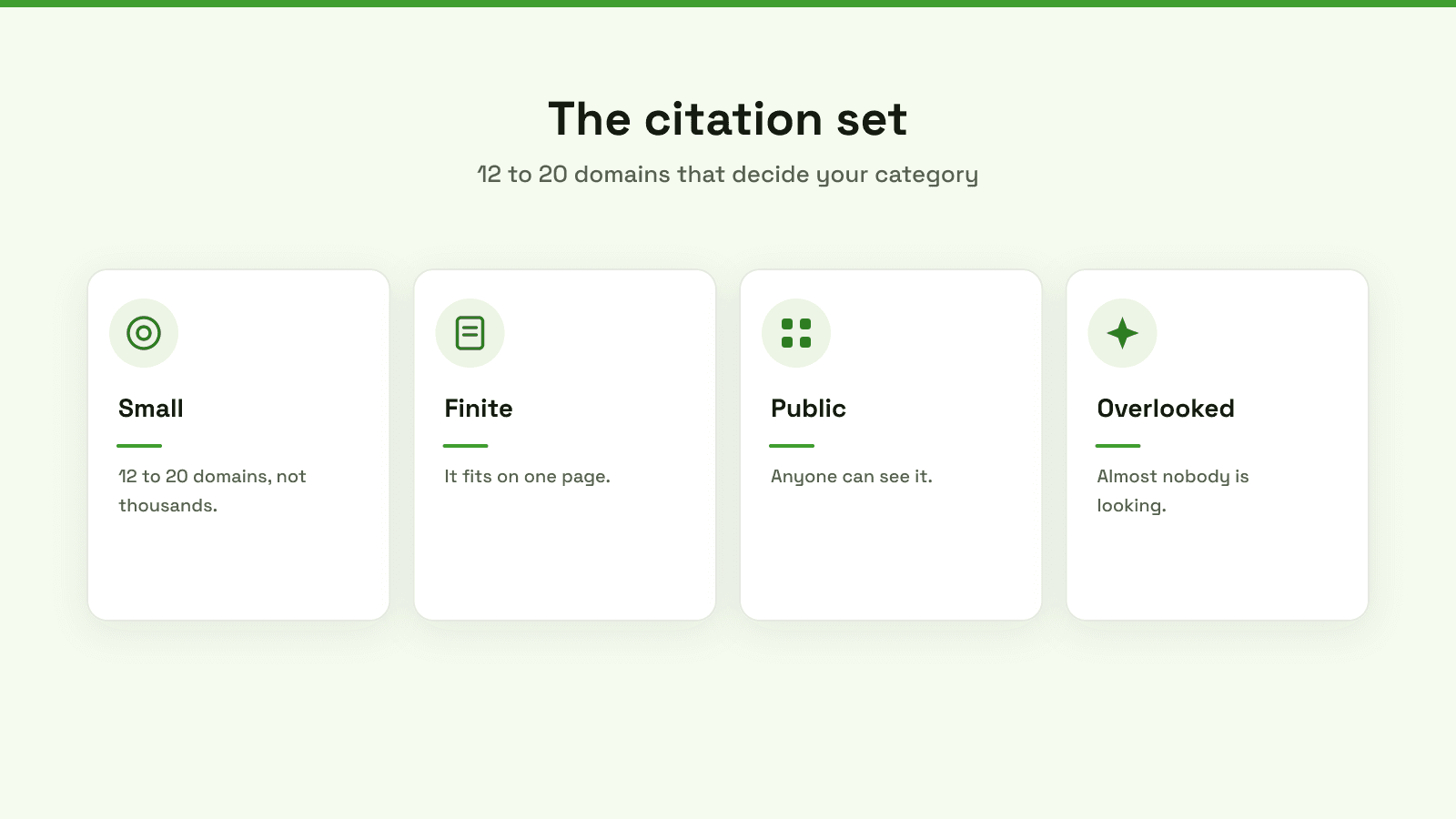
Three things about the citation set make this work, and I lean on all three. It is small, usually 12 to 20 domains, not thousands. It is finite and knowable, so you can write it down on one page. And it is fully public. Anyone can see it, and almost nobody in the category is looking. When I audit a store, it usually sits at 0 mentions across 30 buying questions while one competitor sits at around 9, almost always off a single old listicle. That gap is not talent. It is that one of them found the list.
Why it works
Be precise here, because this is where people get it wrong. There are two ways a brand ends up in an AI answer. The first is retrieval: the model runs a live search, pulls sources, and writes from them. That is what produces the visible citations, and it responds within days to weeks. The second is model memory from training, which is slow, opaque, and outside anyone's control on a 14-day horizon. The Citation Loop works on the retrieval path. I am not claiming it retrains the model or changes what the model knows. It changes what the model can retrieve about you right now, which is the part you can actually move.
So be careful what you call this. It is not keyword SEO; the input and the unit of victory are both different. It is not adding llms.txt or schema markup; those help a model parse your site once it arrives, they do not put you on the citation list. It is not content volume; I have watched stores publish 50 posts nobody cites, and nothing moved. It is not a hack; the sources are public and the work is real outreach and real content. And it is not permanent; answers shift, so the loop repeats.
Why I built Shoptank to run it
I ran the early versions by hand, and the arithmetic is what ended that. 30 questions across 4 models is 120 queries. Each answer carries 5 to 15 sources, so that is 600 to 1,800 URLs to open and log for one store. Then you do it again 14 days later, because the answers have moved. That does not scale past a handful of stores, and LibauAI has 5,000 or more merchants across 50 or more countries. So I built Shoptank to run the loop: it pulls the questions, queries ChatGPT and Claude (Perplexity is on the roadmap), logs the sources, maps the citation set, and re-runs on the 14-day clock. Over 12 months, the method Shoptank automates has driven 100,000 dollars or more in merchant revenue attributed to ChatGPT, Claude and Perplexity, tracked from referral traffic on those domains through to orders. If you want the fix side, start with why ChatGPT skips a store, and I compared the tools in this space in our roundup of AI visibility tools for Shopify.
Your category has a citation set right now. 12 to 20 domains, sitting on one public page, and almost nobody in your category is reading it. Most stores I check sit at 0 mentions across 30 buying questions. One competitor sits at around 9. The only question that matters is whether you find your list before they defend it.