How to See Which Sources AI Assistants Cite When They Recommend Products in Your Category
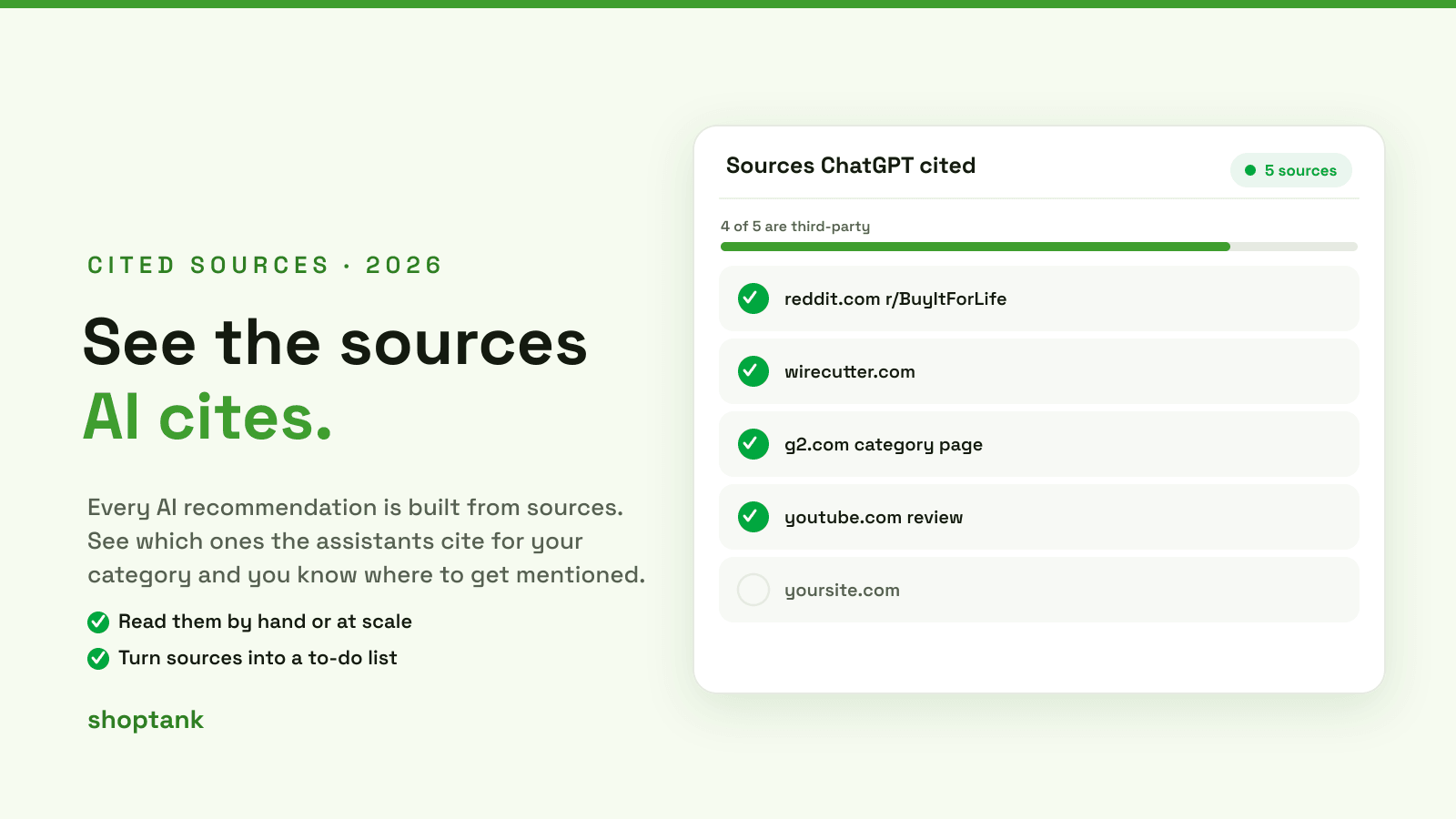
Every AI recommendation is assembled from sources. The assistant searches, pulls back a few pages it trusts, and writes its answer from them. That means the cited sources are the single most useful thing you can look at: they are a map of exactly where you need to be mentioned to get recommended in your category. Here is how to read that map, by hand and at scale.
Key takeaways
- The brands in an answer are the brands in its sources. See the sources and you see your to-do list.
- Perplexity always shows sources; ChatGPT and Claude show them when they browse the web.
- Track the domain, source type, and who is named across many queries to find the sources that matter most.
- Manual checks work for a few queries; a tracker scales it and shows change over time.
The source types AI cites most

Across categories, four source types come up again and again: community threads like Reddit and Quora, review sites like G2 and Wirecutter, editorial roundups and best-of lists, and video, especially YouTube. Your own site appears too, but usually as one voice among several. Knowing the mix in your category tells you where to spend your effort.
Reading sources by hand

- Ask your buyer query in the assistant, with web search on. Use the exact phrasing a customer would.
- Open the cited pages the answer links to. Perplexity lists them under the answer; in ChatGPT and Claude they appear when the model has searched.
- Log the domain and source type for each: community, review site, roundup or video.
- Note who is named. Is your competitor there? Are you? That gap is the point.
Repeat across ten or twenty queries and the pattern appears: the same few domains keep showing up, and the same names keep getting cited. If you are not one of them, you now know precisely where to change that. For the why behind it, see why your competitor keeps showing up.
Doing it at scale
Reading sources by hand is a great first exercise, but it does not scale and it does not tell you what changed since last month. That is what a tracker is for. Shoptank runs your queries across ChatGPT and Claude (Perplexity is on the roadmap) on a schedule and records every source each answer cited, so you get one living list of the domains that matter, who is named on each, and where your gaps are. You can even connect it to Claude and ask, in the chat, which sources cite your competitor and not you.
Turn sources into recommendations
The point of seeing the sources is acting on them. Once you have the list, earn a genuine mention on each: here is the step-by-step to get recommended by ChatGPT. Start free and pull your first source list in a couple of minutes.