AEO and GEO for Shopify: The Complete 2026 Guide
AEO gets your store into the answer. GEO gets you cited as the source. Both matter now, because your buyers have stopped scrolling a page of links and started reading a single AI answer instead. This guide covers what AEO and GEO mean for a Shopify store, how they differ, the combined playbook, and how to measure whether any of it is working.
Key takeaways
- AEO optimizes your store to be the direct answer. GEO optimizes it to be the cited source inside a generated answer.
- They share most of the same work, so a Shopify store should do both together, not choose one.
- The levers are structured data, a citable knowledge base, clean product data, and third-party mentions.
- You cannot improve what you do not measure, so track your rank per query and engine. Shoptank does this and starts free.
On this page
- What AEO and GEO mean
- AEO vs GEO: the difference
- Why Shopify stores need both
- The combined playbook
- The signals both reward
- How to measure it
What AEO and GEO mean
Answer engine optimization (AEO) is the work of structuring content so an answer engine can lift a direct answer straight from it. Generative engine optimization (GEO) is the work of becoming a source that a generative model trusts enough to cite when it writes an answer. Both are a response to the same shift: search is moving from a list of links to a single synthesized answer.
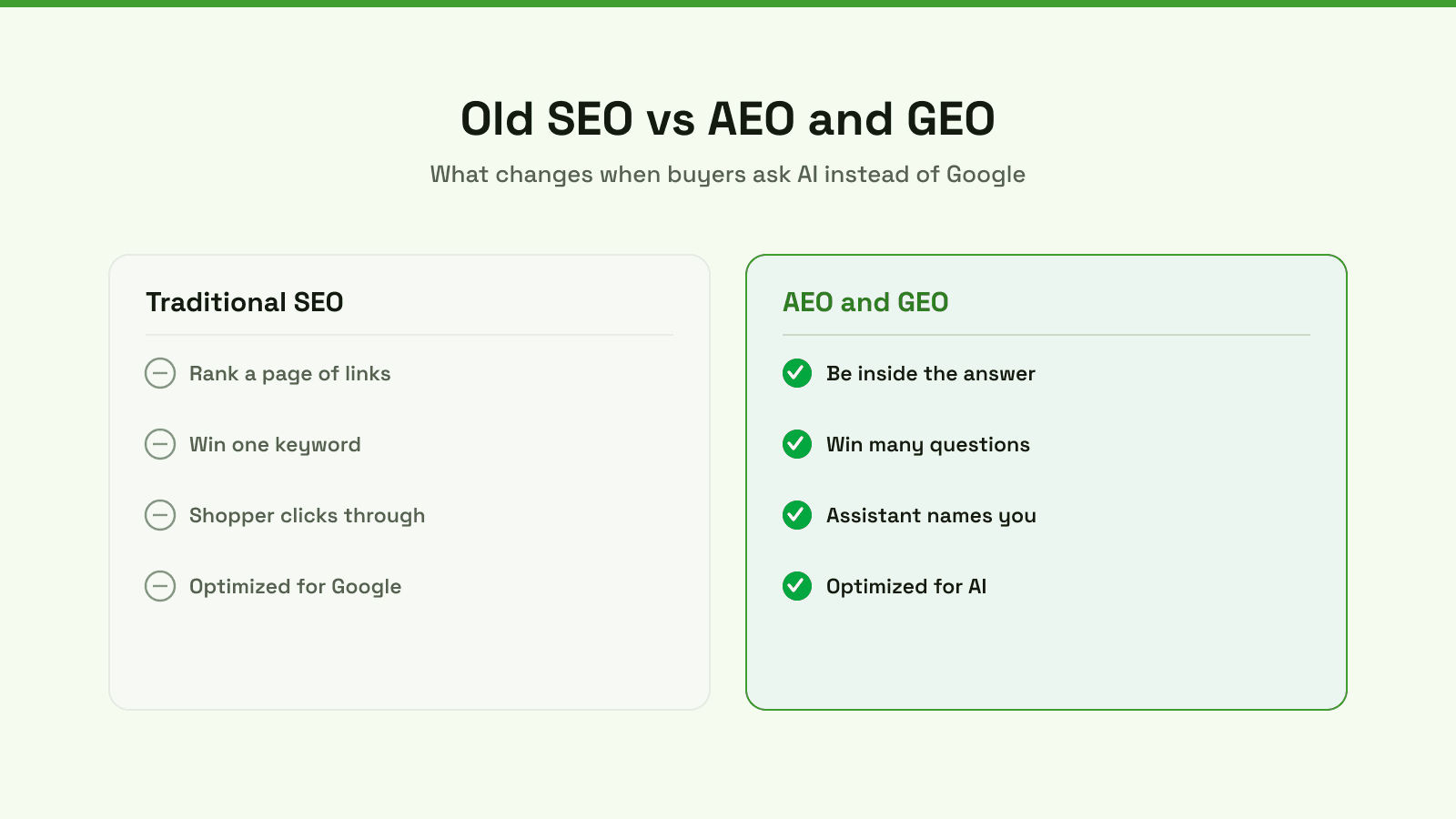
The contrast with classic SEO is the fastest way to understand it. SEO fights to rank a page so a shopper clicks through. AEO and GEO fight to put your store inside the answer, so the shopper never needs the list of links at all. Different job, different unit of victory.
AEO vs GEO: the difference
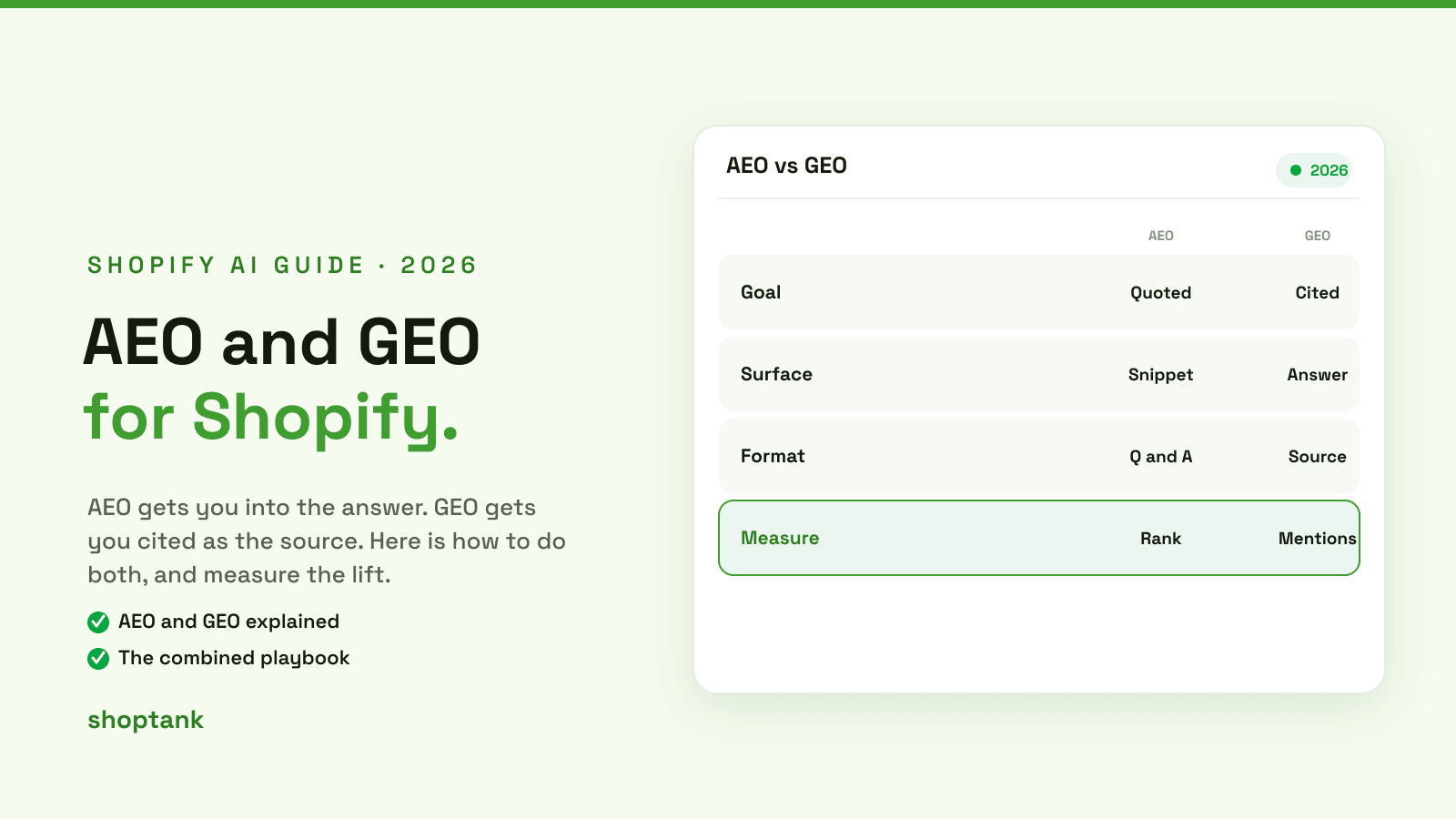
AEO is about being quoted. GEO is about being cited. AEO targets the direct-answer surfaces: featured snippets, voice results and Google's AI Overviews, where the engine pulls one clean answer. GEO targets the generated answer itself, where an assistant like ChatGPT or Perplexity writes a paragraph and lists the sources it used. You want to be in both places, and the good news is that the work overlaps so heavily that separating them is mostly academic.
A useful way to hold it: AEO makes your content extractable, GEO makes it citable. Extractable content is clearly structured and answers one question at a time. Citable content is factual, sourced, and trusted enough that a model is willing to stake its answer on it. For a deeper treatment of the citation side, see the Citation Loop, and for the AEO definition on its own, see what answer engine optimization is.
Why Shopify stores need both
Your buyers are now split across two habits. Some still start on Google, where an AI Overview answers before the blue links, and that is AEO territory. Others open ChatGPT or Perplexity and ask directly, and that is GEO territory. Semrush found that roughly 88 percent of AI Overviews answer informational queries, which is exactly the kind of question a shopper asks before buying. Cover only one surface and you hand the other to a competitor.
Shopify gives you the foundation for both. Agentic Storefronts and the universal catalog put your products into the pipeline AI shops from. But being in the catalog is not the same as being recommended, which is the gap the catalog alone does not close. AEO and GEO are what turn a listed store into the named one.
The combined playbook
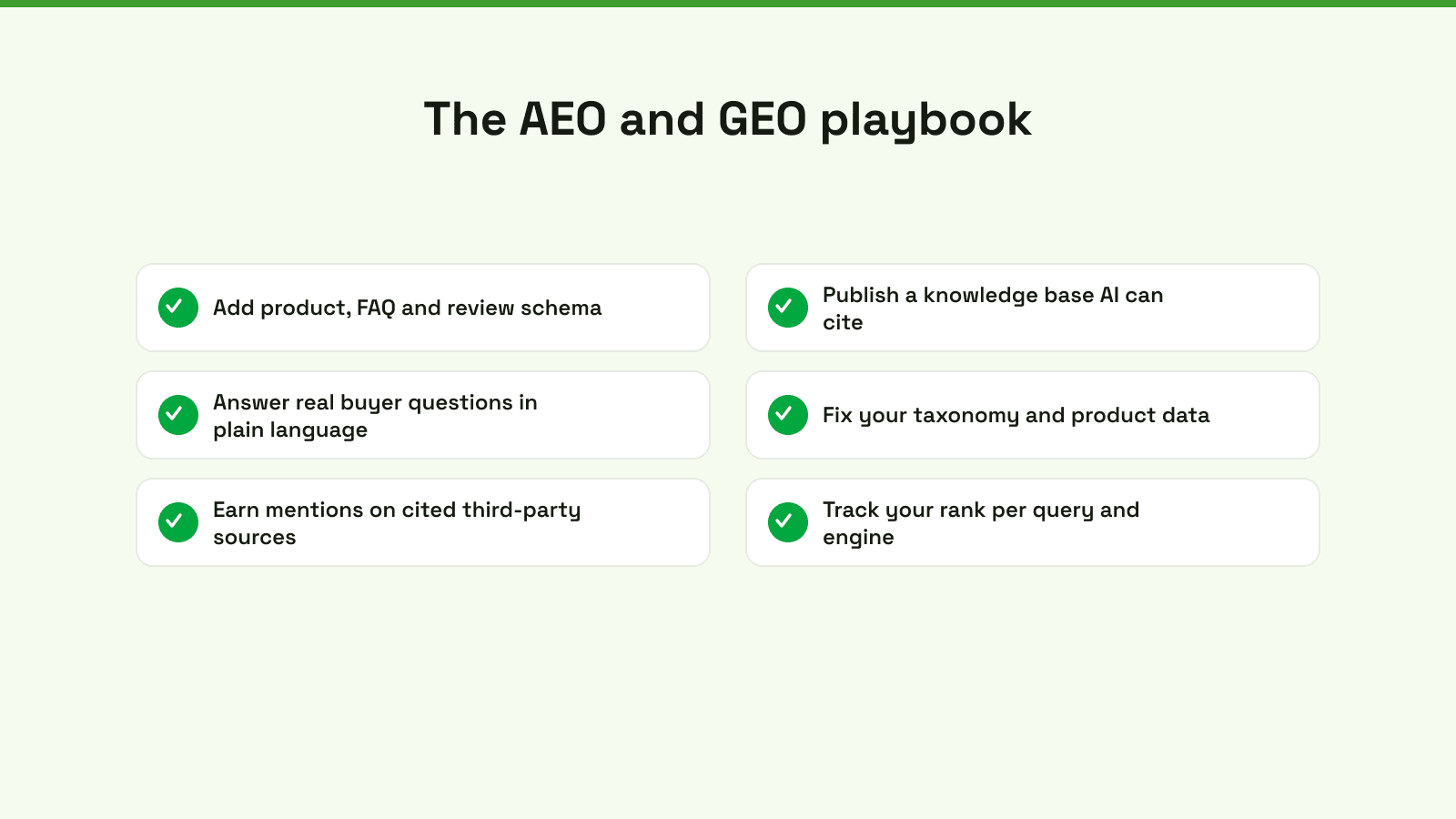
Because AEO and GEO share their inputs, one playbook covers both. Run it in this order.
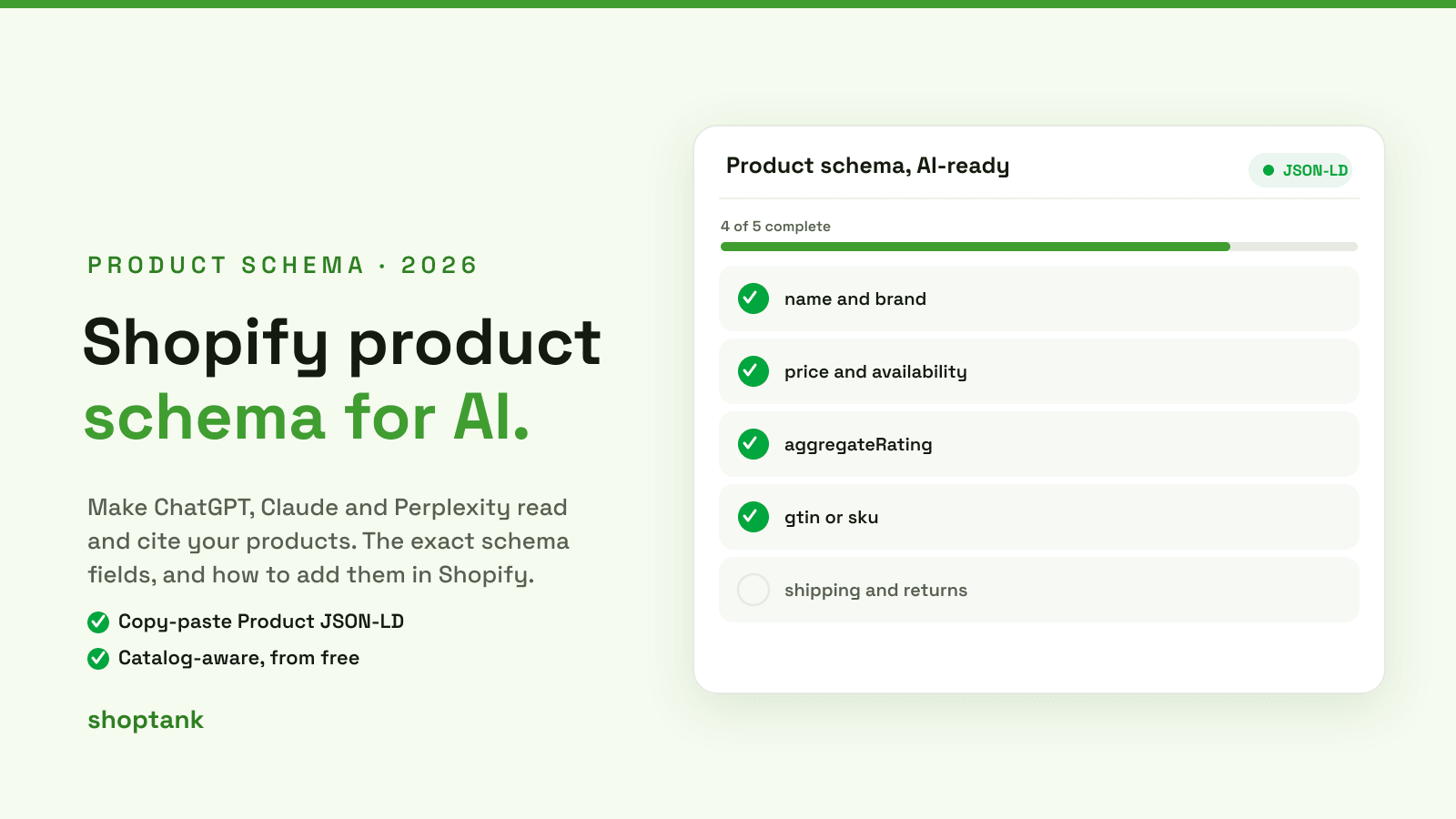
- Add product, FAQ and review schema. Structured data is how machines read your pages. Start with the schema that matters most for stores, covered in how to add schema markup.
- Publish a knowledge base AI can cite. Put your brand facts and buyer answers in a format assistants ingest. This is the single biggest GEO lever, explained in the AI knowledge base guide.
- Answer real buyer questions in plain language. Lead each answer with the answer, in 40 to 60 words, then expand. That is the shape both snippets and generated answers pull from.
- Fix your taxonomy and product data. An engine cannot recommend what it cannot categorize. See taxonomy and metafields for AI.
- Earn mentions on cited third-party sources. Get onto the listicles, comparison pages and threads an engine already pulls from, because a brand is far more likely to be cited through a third party than from its own site.
- Track your rank per query and engine. Measurement closes the loop, covered below.
The signals both reward
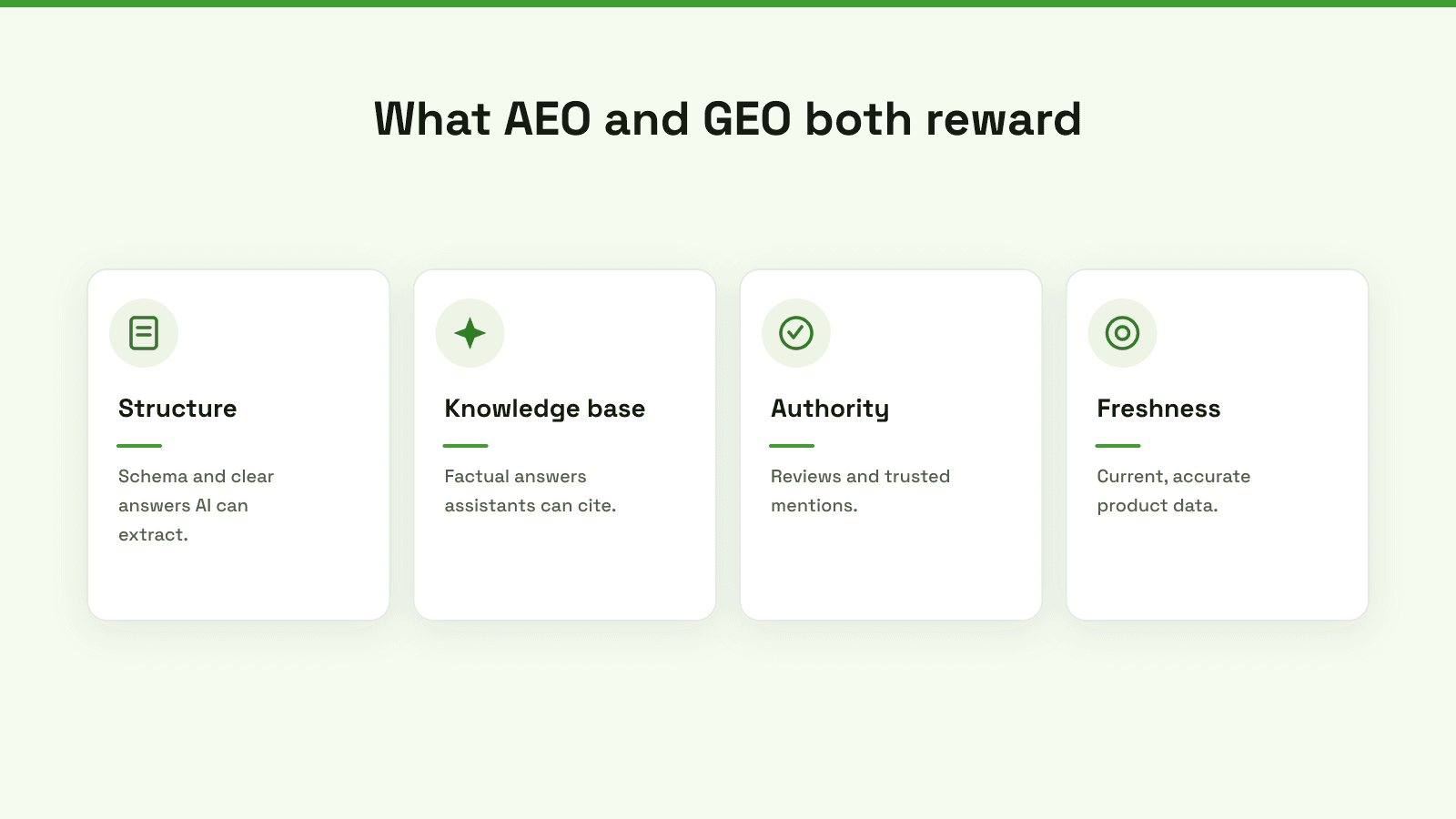
Underneath the steps, AEO and GEO reward the same four things, so it is worth optimizing for the signals directly. Structure, so the answer is easy to extract. A knowledge base, so there is something factual to cite. Authority, from reviews and trusted mentions, so a model believes you. And freshness, because engines weight current, accurate data over stale pages. Princeton's 2024 study of generative engines found that citing sources and adding statistics were among the highest-impact moves, each lifting visibility by around 40 percent, which is authority and structure doing their job.
How to measure it
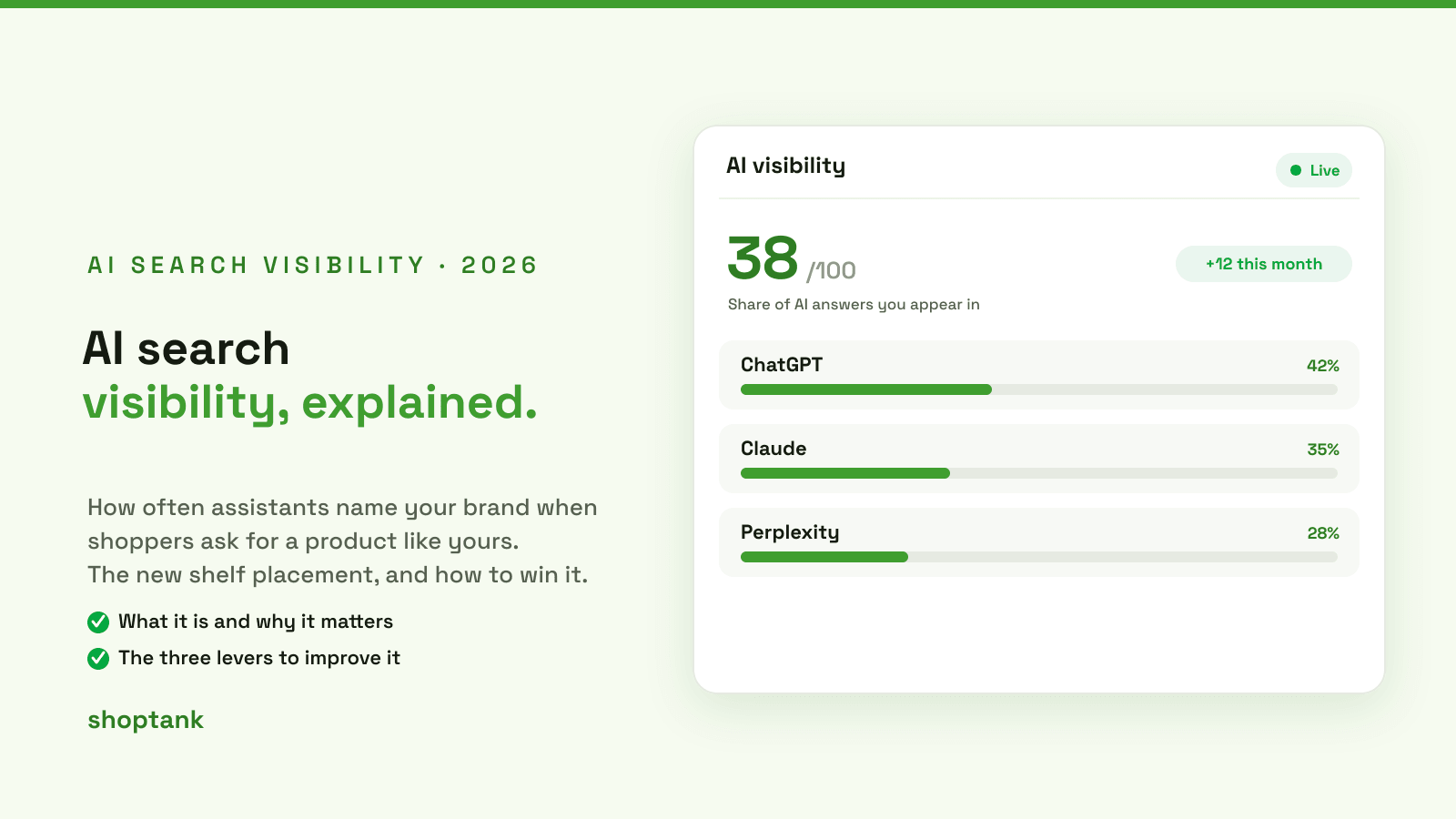
AEO and GEO are only as good as your ability to see them. The metric is simple: for each of your real buyer queries, are you mentioned, are you cited, and what position do you hold, across each engine? Watch that move week over week as your fixes land.
Shoptank is the Shopify app that runs this measurement for you. It tracks how your store ranks for your buyer queries across ChatGPT and Claude, shows which brands are recommended instead of you, and drafts the fixes from the playbook above. It starts free, so you can see exactly where your AEO and GEO stand today. To go further, compare the options in the best AI visibility tools for Shopify, learn GEO for Shopify on its own, or read why ChatGPT skips some stores.
AEO gets you into the answer. GEO gets you cited in it. The stores that win the next few years are the ones treating both as one job, and measuring it. On Shopify, you can see where you stand for free.